The question comes up every budget cycle, every time a new channel needs resourcing, and every time a marketing leader looks at their team’s output relative to their cost.
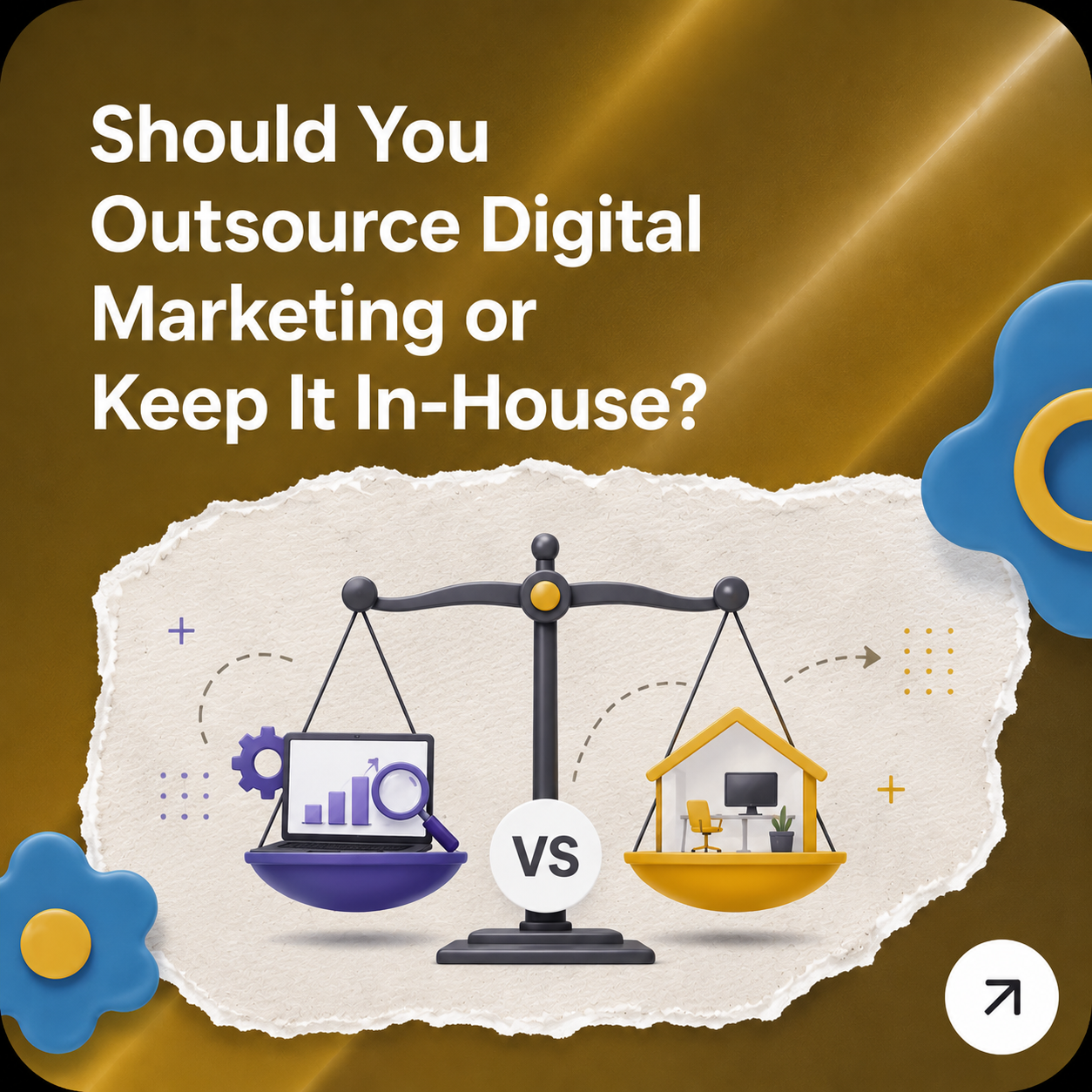
Should we outsource digital marketing, or build the capability ourselves?
The framing of in-house marketing vs agency is often treated as a binary. It is not. The more precise question is: which marketing functions are better served by in-house resource, which by external partners, and what does the right combination look like given your business stage, team capability, and commercial objectives?
This guide provides the framework for answering that question with more rigor than gut feel or budget pressure typically allows.
The Real Cost of In-House Marketing (Beyond Salaries)
The headline cost of an in-house marketing team is salaries. The full cost is considerably higher, and it is the full cost that the outsourcing decision needs to be evaluated against.
Beyond base salaries, in-house marketing teams require:
- Employer costs: Benefits, employer contributions, and payroll taxes typically add 20 to 30% to base salary cost.
- Management overhead: In-house marketing teams require management time from senior leaders who could otherwise be focused on strategy and commercial output.
- Tool and platform subscriptions: SEO platforms, analytics tools, project management software, design tools, paid media dashboards, and content management systems represent a significant annual cost that small in-house teams rarely amortize efficiently.
- Training and development: Digital marketing evolves continuously. Keeping an in-house team current across SEO algorithm changes, paid media platform updates, and content strategy developments requires ongoing investment.
- Recruitment and onboarding: The average cost of recruiting and onboarding a mid-level marketing hire in most markets is equivalent to three to six months of their salary. In a tight talent market, this cost is higher.
- Opportunity cost of under-utilization: In-house specialists are fixed costs. When campaign volume is low or priorities shift, they are being paid for capacity that is not being used.
This does not mean in-house is always more expensive than outsourcing. It means the comparison needs to be made on total cost, not salary line.
The Real Cost of Outsourcing Digital Marketing (Beyond Agency Fees)
The headline cost of outsourcing is the agency or partner fee. The full cost includes the internal resource required to manage the relationship effectively.
- Brief quality investment: External partners need thorough, well-documented briefs to produce work that reflects your brand and commercial context. Building and maintaining these briefs requires internal time.
- Review and approval cycles: Every piece of work produced by an external partner needs internal review before it reaches clients or goes live. This review time is part of the real cost of the outsourcing model.
- Relationship management: Outsourced marketing relationships require active management. A partner who receives no strategic direction or feedback will drift from your needs over time.
- Transition and onboarding costs: Moving to a new agency or partner involves onboarding time, knowledge transfer, and a performance ramp-up period before the partner is operating at full effectiveness.
The outsourcing model is most economical when the internal management overhead is low and the external delivery quality is high. Both of these are choices, not givens.
Companies that structure outsourced marketing with a clear internal owner and a thorough brief process report 40% fewer revision cycles and significantly higher satisfaction with output quality versus those that outsource without internal governance. Source: Gartner, Marketing Outsourcing Effectiveness Survey, 2024
In-House Marketing vs Agency: The Decision Framework
The decision between in-house and outsourced marketing should be made function by function, not for marketing as a whole. Different functions have different outsourcing profiles based on three variables: strategic sensitivity, delivery complexity, and volume variability.
MARKETING FUNCTION | STRATEGIC SENSITIVITY | OUTSOURCES WELL? | RECOMMENDED MODEL |
Brand strategy and positioning | High | No | Keep in-house |
Content strategy and editorial direction | High | No | Keep in-house |
SEO content production | Medium | Yes | Outsource with strong brief |
Paid media strategy | High | Partial | Hybrid: strategy in-house, execution outsourced |
Paid media execution | Low-Medium | Yes | Outsource |
Social media strategy | High | No | Keep in-house |
Social media content production | Medium | Yes | Outsource with brand guidelines |
Email marketing strategy | High | Partial | Hybrid |
Email production and deployment | Low | Yes | Outsource |
Technical SEO | Medium | Yes | Outsource to specialist |
Analytics and reporting | Medium | Yes | Outsource with defined KPI set |
Benefits of Outsourcing Digital Marketing
The case for outsourcing specific marketing functions rests on four genuine advantages that in-house teams structurally cannot replicate.
Specialist depth on demand
No in-house team can maintain world-class expertise across every marketing discipline simultaneously. A specialist white label or outsourced provider focused on a single function – technical SEO, paid search, programmatic, email automation – has deeper capability in that area than a generalist in-house team can develop while covering a broad remit.
Variable cost structure
Outsourced delivery costs scale with your actual marketing volume. In-house teams are fixed costs. For organizations with seasonal demand, variable campaign volume, or growth-stage uncertainty, the variable cost model is structurally more efficient.
Speed of capability access
Adding a new channel in-house requires recruiting, hiring, and onboarding a specialist before a single campaign can run. An outsourced partner with an existing capability can be briefed and producing output in days to weeks.
Cross-client perspective
Specialist agencies and outsourced partners bring pattern recognition from working across multiple clients and industries simultaneously. An in-house team’s reference set is, by definition, limited to a single organization. For channels where best practice evolves quickly, this external perspective has genuine value.
When In-House Is the Right Answer
In-house marketing is the right structural choice for functions that are genuinely differentiating, deeply brand-sensitive, or where the accumulated knowledge of your organization is the primary source of competitive advantage.
- Brand strategy: The core positioning, narrative, and brand architecture of a business cannot be effectively outsourced. It requires intimate knowledge of the organization, its customers, and its competitive context.
- Product marketing: The translation of product capability into market-facing messaging requires deep product knowledge and close collaboration with product and commercial teams. External partners lack the access to do this well.
- Customer data strategy: First-party data assets, audience segmentation strategy, and personalization architecture involve proprietary data that is rarely appropriate to expose to external partners.
- Executive thought leadership: Content that builds the personal brand and public authority of your leadership team requires access, collaboration, and contextual sensitivity that an external partner cannot replicate.
The Hybrid Model: How Most Mature Organizations Actually Structure Marketing
The marketing teams that perform most consistently are not fully in-house and not fully outsourced. They are hybrid: a lean in-house team that owns strategy, brand, and client relationships, supported by specialist external partners for execution-intensive functions.
This is not a compromise between two models. It is the model that gets the most from both. In-house ownership ensures strategic coherence and brand integrity. External specialists ensure execution quality and channel depth. The combination produces better marketing than either model achieves alone.
The hybrid model works when the in-house team is genuinely strong at the functions they own, and when the external partners are genuinely specialist at the functions they deliver. Both conditions require active management.
Outsource Marketing Department Functions: What Works and What Does Not
The most common outsourcing failure mode is not choosing the wrong partner. It is outsourcing the wrong functions. Strategy, brand voice, and customer relationship management outsource poorly because they depend on contextual knowledge that external partners cannot accumulate quickly enough to be effective. Execution, production, and channel-specific technical work outsource well because they can be thoroughly specified, quality-checked, and iterated on.
The second failure mode is outsourcing without internal governance. Every function that is outsourced needs an internal owner who sets the brief, reviews the output, and maintains accountability for the quality of what reaches the market.
Hiring a Marketing Agency: What to Evaluate Beyond the Pitch
The pitch tells you what an agency wants you to believe about them. The evaluation process should test what is actually true.
- Ask for work samples from clients in your category: Generic case studies demonstrate capability. Category-specific examples demonstrate relevance.
- Talk to their current clients, not their references: References are selected. Current clients who were not offered as references will give you a more accurate picture of day-to-day delivery quality.
- Understand who actually does the work: The senior team presents the pitch. The junior team delivers the work. Understand exactly who will be working on your account and at what seniority.
- Test the brief process before you sign: Ask the agency to produce a brief or a sample deliverable based on a real project. How they handle the brief process is a more reliable predictor of delivery quality than any pitch deck.
How IMS nHance Works with Brands and Enterprise Teams
IMS nHance provides outsourced and white label digital marketing delivery for brands and enterprise marketing teams that need specialist execution capacity without expanding their in-house headcount. We work across content strategy and production, SEO, paid media execution, social media content, and analytics reporting.
For brands evaluating whether to outsource specific marketing functions, we offer a structured scoping process that identifies where external delivery would genuinely improve output quality and cost efficiency, and where in-house ownership is the right structural choice.
Conclusion
The outsource vs in-house decision is not a one-time choice. It is an ongoing structural question that should be revisited as your marketing function matures, your team capability evolves, and your commercial objectives change.
The organizations that get the most from their marketing investment are those that are clear about which functions require in-house ownership and which functions benefit from specialist external delivery – and that build the governance to make the combination work.
If you are evaluating how to structure your marketing delivery model, talk to IMS nHance about where outsourced execution would make the most difference for your team.