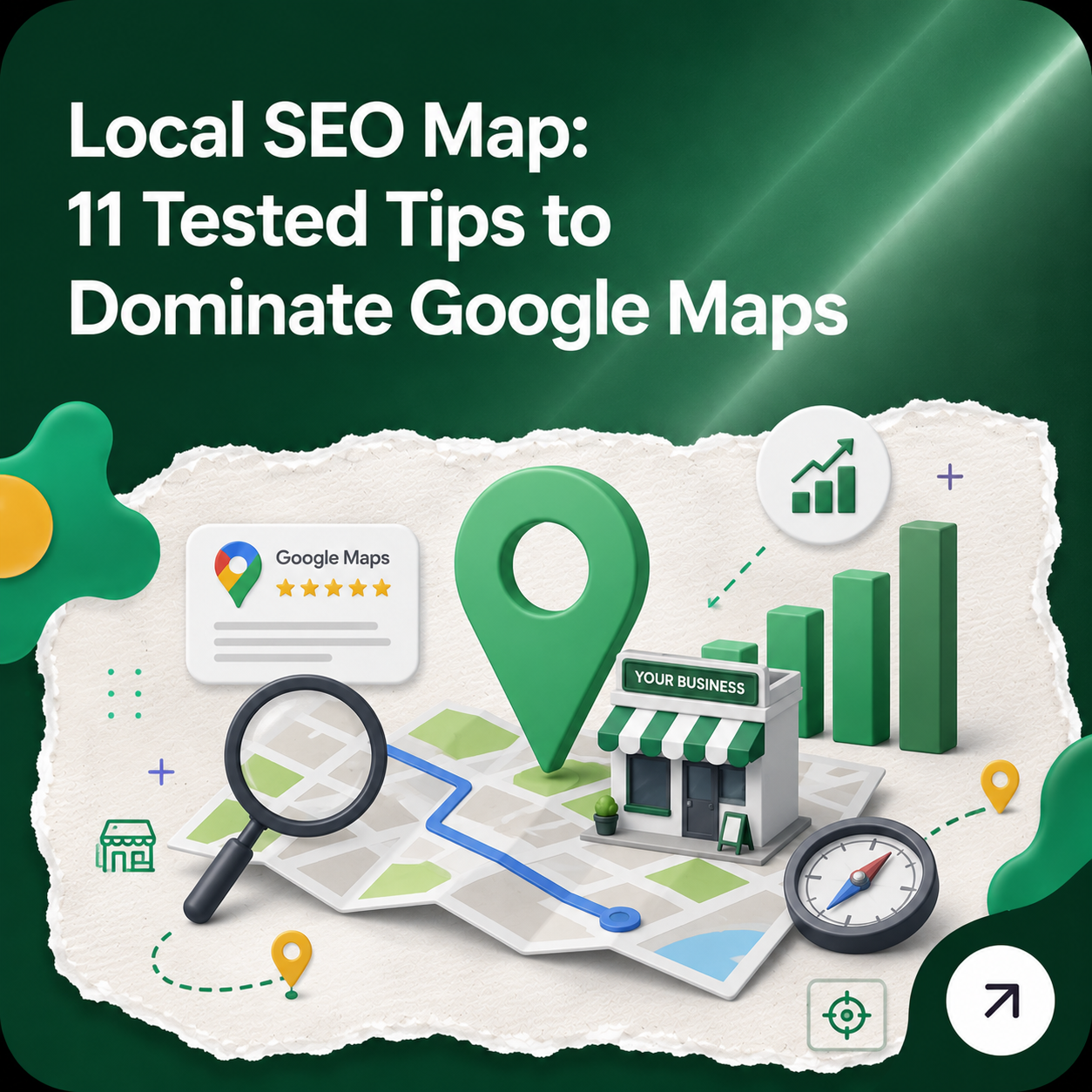
Google Maps is not just a navigation tool. For local businesses, it is the first screen of the sales process.
When someone searches for a service near them, the Map Pack – the three local listings that appear above organic results – captures more clicks than anything below it. Ranking in that pack, or ranking higher within it, is not a vanity metric. It is a direct driver of calls, visits, and revenue.
The factors that determine Google Maps ranking are knowable, and the tactics that move them are testable. This guide covers 11 of the most consistently effective, drawn from what actually works across local SEO campaigns rather than what the algorithm theoretically values.
How Google Maps Ranking Actually Works
Google Maps ranking is determined by three core factors, which Google refers to as relevance, distance, and prominence.
- Relevance: How well your listing matches what the searcher is looking for. This is influenced by your business category, your profile completeness, and the keywords present in your business name, description, and reviews.
- Distance: How far your business is from the searcher or from the location specified in the search query. This factor is partially outside your control, but optimizing the others matters more than proximity for competitive searches.
- Prominence: How well-known and authoritative your business is, as determined by online reviews, backlinks, citations, and the overall strength of your web presence. This is the most lever-rich factor for active optimization.
The tactics below are organized around moving one or more of these three factors. Some are quick wins. Some require sustained effort. All have demonstrated consistent results across local SEO campaigns.
46% of all Google searches have local intent. Businesses in the Google Maps 3-Pack receive 44% of total clicks on local search results pages. Source: BrightLocal, Local Search Consumer Survey 2024
Tip 1: Complete and Optimize Every Section of Your Google Business Profile
Your Google Business Profile (GBP) is the primary data source for your Maps listing. Google uses the information in your profile to assess relevance and to populate the listing that searchers see.
A complete profile means every available field is filled in: business name, address, phone number, website, hours (including special holiday hours), business description, service areas, attributes, and product or service listings where applicable.
The business description is frequently underused. It should include your primary service keywords and location naturally within the first 250 characters, since this is the portion most visible in search results. The full 750-character allowance should describe what makes your business genuinely useful to local searchers.
The optimization test: Open your GBP dashboard and check for any sections showing as incomplete or prompting you to add information. Google surfaces these gaps because it knows they affect ranking. Every gap is an opportunity.
Tip 2: Choose Your Primary Category with Precision
Your primary category is one of the most influential signals in your Maps ranking. It tells Google which searches your business is relevant for, and it directly affects which queries you appear for.
The right primary category is the most specific accurate description of what your business primarily does — not the broadest category you can claim, and not an adjacent category that captures more search volume. Google penalizes category stuffing and rewards category accuracy.
Secondary categories should be used for genuine secondary services your business provides. Most businesses can legitimately claim two to five categories. The primary category carries the most weight.
The research method: Search for your primary service in your location and look at the categories listed on the top-ranking Map Pack results. These are the categories Google has assessed as most relevant for that search. If they differ from your current selection, investigate why and adjust accordingly.
Tip 3: Build and Maintain NAP Consistency Across Every Directory
NAP – Name, Address, Phone Number – consistency is a foundational local SEO requirement. Google cross-references your business information across directories, data aggregators, and third-party platforms to verify that your business is legitimate and accurately represented.
Inconsistencies – a different phone number on Yelp, an abbreviated address on a local directory, an old location on a data aggregator – create conflicting signals that reduce Google’s confidence in your listing and suppress your ranking.
A NAP audit involves searching for your business name across the major directories (Google, Bing Places, Apple Maps, Yelp, Facebook, TripAdvisor where relevant) and the major data aggregators (Foursquare, Data Axle, Localeze). Any inconsistency should be corrected at the source.
Priority fix: Your NAP on your website – particularly in the footer and on your contact page – should exactly match the NAP on your Google Business Profile. This is the reference point Google trusts most.
Tip 4: Generate a Consistent Flow of Recent Reviews
Reviews influence Maps ranking through two mechanisms: the total volume of reviews signals prominence, and the recency of reviews signals that the business is actively trading and being chosen by customers.
A business with 200 reviews accumulated over five years will typically rank below a competitor with 80 reviews accumulated over the last 12 months, because recency signals current relevance. Both volume and recency matter.
The most effective review generation approach is a systematic ask at the moment of highest satisfaction — typically immediately after a positive interaction, delivery, or service completion. A direct link to your Google review page, sent via SMS or email with minimal friction, produces significantly higher completion rates than a generic request.
What not to do: Never incentivize reviews, purchase reviews, or ask for reviews in bulk from people who have not genuinely used your service. Google detects these patterns and the ranking penalty for review manipulation is severe and difficult to recover from.
Businesses that actively request reviews generate 4x more reviews than those that wait passively. Average star rating has a stronger correlation with click-through rate from the Map Pack than any other visible listing element. Source: BrightLocal, 2024
Tip 5: Respond to Every Review Within 48 Hours
Review responses are a ranking signal and a conversion signal simultaneously. Google has confirmed that responding to reviews helps your business appear more prominently in local search. Searchers who read reviews also read responses – and the quality of responses shapes their perception of your business before they contact you.
Responses to positive reviews should be genuine and specific, referencing something from the review rather than using a template. Responses to negative reviews should acknowledge the issue, avoid defensiveness, and offer a path to resolution. Both types of response signal active business management to both Google and prospective customers.
The 48-hour window is a practical standard. Reviews that go unanswered for weeks or months suggest a business that is not monitoring its reputation, which is a negative signal in both algorithmic and human terms.
Tip 6: Add Photos Regularly - and Make Them Genuine
Google Business Profiles with photos receive significantly more direction requests and website clicks than those without. Photos are also a ranking signal: profiles with regular photo additions signal active business management, and Google factors this into prominence assessment.
The photos that perform best are genuine images of the business, team, products, and work – not stock photography. Google’s image recognition systems can identify stock images and they do not carry the same weight as original photos. Customers can also identify stock photography and it reduces trust.
A regular cadence matters more than a large one-time upload. Adding three to five genuine photos per month is more effective for maintaining ranking signals than uploading 50 photos at once and then stopping.
Photo categories to cover: Exterior (for navigation and recognition), interior (for trust), team (for humanization), products or work examples (for relevance), and any seasonal or event-specific content that demonstrates active operation.
Tip 7: Use Google Posts to Signal Active Engagement
Google Posts are short updates published directly through your Google Business Profile. They appear on your Maps listing and in Knowledge Panel results for branded searches. They are one of the clearest direct signals of active business management that you can send to Google.
Posts expire after seven days for standard updates and remain live for event posts until the event date. A posting cadence of at least one post per week maintains the active engagement signal continuously.
Effective post content includes new service announcements, seasonal offers, event information, and content that answers common customer questions. Posts that include a call to action – book, call, learn more – also serve as conversion tools for searchers reading your listing.
Tip 8: Build Local Citations on Authoritative Directories
A local citation is any online mention of your business’s name, address, and phone number. Citations on authoritative, relevant directories contribute to the prominence signal that influences Maps ranking.
Priority directories for most local businesses include Google Business Profile (primary), Bing Places, Apple Maps, Yelp, Facebook, and industry-specific directories relevant to your category. Data aggregators – Foursquare, Data Axle, and Localeze – feed information to hundreds of downstream directories and are high-priority targets for accuracy.
CITATION TYPE | EXAMPLES | PRIORITY |
Core directories | Google, Bing Places, Apple Maps, Yelp | Critical – fix first |
Data aggregators | Foursquare, Data Axle, Localeze | High – feed downstream dirs |
Industry directories | TripAdvisor, Houzz, Healthgrades (by sector) | High – category relevance |
Local directories | Chamber of commerce, local business associations | Medium – local relevance |
Social platforms | Facebook, LinkedIn business page | Medium – brand signals |
Tip 9: Optimize Your Website for Local Keywords and Location Pages
Your website is a significant prominence signal for your Maps listing. Google assesses the strength and relevance of the website linked to your GBP as part of its ranking calculation. A website that is well-optimized for local search strengthens your Maps position.
Local website optimization involves several elements:
- Location-specific title tags and meta descriptions: Every page targeting a specific location should include the location name and primary service keyword in the title tag.
- Location pages for multi-location businesses: Each location should have a dedicated page with unique content, a local phone number, an embedded Google Map, and locally relevant information – not duplicated content with the city name swapped.
- Schema markup: LocalBusiness schema markup on your homepage and location pages explicitly tells Google your business type, address, hours, and contact information in structured data format. This strengthens the connection between your website and your GBP.
- Local keyword integration: Service pages should naturally reference the locations you serve. A plumber in Austin should have content that references Austin, the specific neighborhoods served, and the services offered – not just generic service descriptions with no geographic context.
Tip 10: Earn Local Backlinks from Relevant Sources
Backlinks from locally relevant, authoritative sources are one of the strongest prominence signals for Maps ranking. A link from a local newspaper, a local business association, a community organization, or a complementary local business tells Google that your business is genuinely embedded in the local ecosystem.
Local backlink sources worth pursuing:
- Local press coverage and mentions in local news outlets
- Local business association or chamber of commerce membership pages
- Sponsorship of local events, sports teams, or community initiatives
- Guest content on local industry blogs or community websites
- Partnerships with complementary local businesses that include reciprocal linking
The quality and local relevance of the linking domain matters more than the volume of links. Five links from genuinely local, authoritative sources outperform fifty links from generic directories.
Tip 11: Use the Q&A Feature on Your Google Business Profile Proactively
The Q&A section on Google Business Profiles is visible to anyone viewing your listing. Questions can be asked by anyone – including competitors – and answered by anyone, including business owners.
Most businesses ignore this feature entirely, which means questions go unanswered or receive answers from third parties who may be inaccurate or unhelpful.
The proactive approach is to seed your own Q&A section with the questions your customers most commonly ask, and answer them authoritatively. This serves three purposes: it gives Google more keyword-rich, relevant content on your listing; it serves prospective customers who are researching before contacting you; and it prevents inaccurate community answers from becoming the default response to common questions.
Implementation: Log out of your Google account (or use a different device), search for your business, and use the Q&A feature to post the five to ten questions customers most frequently ask. Then log back in as the business owner and answer each one thoroughly.
How IMS nHance Supports Local SEO
IMS nHance provides white label local SEO services for agencies delivering Google Maps optimization to their clients. Our local SEO delivery covers Google Business Profile setup and optimization, citation building and NAP auditing, local content production, review strategy implementation, and monthly performance reporting – all delivered under your agency brand.
For brands managing multi-location SEO programs, we provide scalable local SEO execution that maintains consistency across locations while supporting location-specific optimization where it matters.
Conclusion
Dominating Google Maps is not a single-action project. It is an ongoing program of profile maintenance, review generation, citation management, website optimization, and local link building – each of which reinforces the others.
The businesses that rank consistently at the top of the Map Pack are those that have treated local SEO as a sustained discipline rather than a one-time setup task. The 11 tactics in this guide are the foundation of that discipline.
If your agency needs white label local SEO delivery for your clients, or if you are looking to build a scalable local SEO program across multiple locations, talk to IMS nHance.