Today’s marketing teams have access to more technology than ever before.
From CRM platforms and marketing automation software to analytics dashboards, customer data platforms (CDPs), AI-powered content tools, SEO platforms, advertising solutions, and customer journey orchestration – businesses are investing heavily in technology to improve marketing performance.
Yet many organizations continue to struggle with disconnected systems, fragmented customer data, manual processes, and underutilized software.
The problem isn’t the lack of technology.
The problem is the lack of strategy behind it.
This is where MarTech consulting becomes a competitive advantage.
Instead of purchasing more marketing tools, businesses need a structured approach that aligns technology with business goals, customer journeys, marketing operations, and measurable outcomes.
Whether you’re building your first B2B MarTech stack, improving existing MarTech integrations, evaluating MarTech services, or implementing MarTech cost optimization best practices, the right consulting strategy ensures your technology works as one connected ecosystem – not as isolated platforms.
What Is MarTech Consulting?
MarTech consulting is the process of helping businesses plan, implement, integrate, optimize, and manage their marketing technology ecosystem to improve operational efficiency, customer engagement, and business growth.
Rather than recommending software for the sake of technology, a MarTech consultant evaluates how marketing, sales, customer experience, and data work together before identifying the right combination of platforms and processes.
A successful MarTech consulting engagement typically includes:
- Marketing technology assessment
- Current technology audit
- MarTech strategy development
- Technology selection
- MarTech integrations
- Marketing automation implementation
- CRM optimization
- Analytics and reporting
- Customer journey mapping
- Performance optimization
The objective isn’t simply to adopt more technology.
It’s to create a connected marketing ecosystem that enables faster execution, better customer experiences, and measurable business results.
Quick Definition
MarTech consulting helps organizations build, optimize, and integrate their marketing technology ecosystem by aligning people, processes, data, and technology with business objectives.
Why Businesses Are Investing More in MarTech Consulting
Marketing has evolved dramatically over the last few years.
Customer journeys have become more complex.
Marketing channels have multiplied.
AI has changed content creation and campaign management.
Customer expectations continue to rise.
As a result, organizations are managing dozens of platforms across marketing and sales.
Unfortunately, many businesses experience challenges such as:
- Duplicate software subscriptions
- Inconsistent customer data
- Manual campaign management
- Disconnected reporting
- Limited automation
- Poor attribution
- Low platform adoption
- Inefficient workflows
Without a structured MarTech strategy, technology investments often become operational expenses rather than business assets.
MarTech consulting helps organizations eliminate these inefficiencies by creating an ecosystem where every technology investment contributes toward measurable growth.
Signs Your Business Needs MarTech Consulting
Many organizations don’t realize they need MarTech consulting until technology becomes difficult to manage.
If any of the following challenges sound familiar, it may be time to review your marketing technology strategy.
1. Your Marketing Tools Don't Communicate
Your CRM stores customer information.
Your marketing automation platform manages email campaigns.
Your analytics platform measures website performance.
Your advertising platforms generate leads.
Yet none of these systems exchange information effectively.
Disconnected systems create inconsistent customer experiences and unreliable reporting.
Strong MarTech integrations ensure your technology works together rather than independently.
2. You're Paying for Software That Isn't Being Used
Many businesses purchase new platforms every year while existing tools remain underutilized.
This increases operational costs without improving marketing performance.
A MarTech consultant evaluates technology utilization before recommending additional investments.
This forms the foundation of effective MarTech cost optimization best practices.
3. Reporting Takes Too Long
If your marketing team spends hours manually exporting reports from multiple platforms, your technology stack isn’t working efficiently.
Modern marketing should provide real-time insights rather than manual reporting processes.
4. Customer Data Exists in Multiple Places
One customer may exist in:
- CRM
- Email platform
- Google Analytics
- Advertising platform
- Customer support system
Without proper integrations, these systems cannot deliver a unified customer view.
5. Marketing Growth Requires Hiring More People
If every increase in marketing activity requires additional resources, your operations are likely dependent on manual execution rather than scalable systems.
Effective MarTech consulting combines technology, automation, AI, and streamlined processes to help organizations increase output without proportionally increasing operational complexity.
What Do MarTech Services Include?
One of the most common misconceptions is that MarTech services are limited to software implementation.
In reality, modern MarTech consulting encompasses strategy, technology, operations, and continuous optimization.
A comprehensive MarTech engagement may include:
Strategy & Planning
- Marketing technology roadmap
- Technology gap analysis
- Customer journey mapping
- Data strategy
- Marketing operations planning
Technology Implementation
- CRM implementation
- Marketing automation setup
- Customer Data Platform integration
- AI-powered marketing tools
- Analytics configuration
MarTech Integrations
Connecting technologies such as:
- CRM
- Marketing automation
- CMS
- Analytics
- Advertising platforms
- Customer support software
- Sales enablement platforms
These MarTech integrations eliminate data silos, improve reporting accuracy, and create seamless customer experiences across channels.
Marketing Automation
Automation extends far beyond email campaigns.
Modern marketing automation includes:
- Lead nurturing
- Customer segmentation
- Behavioural triggers
- Lifecycle campaigns
- AI-assisted workflows
- Sales notifications
- Customer onboarding
Performance Optimization
After implementation, continuous optimization ensures the technology ecosystem continues delivering measurable business value.
This includes:
- Performance audits
- Workflow optimization
- Platform utilization reviews
- Dashboard improvements
- Marketing attribution
- ROI analysis
Why Technology Alone Doesn't Drive Growth
One of the biggest misconceptions surrounding digital transformation is the belief that purchasing better software automatically improves marketing performance.
Technology is only one component of an effective marketing ecosystem.
Successful organizations combine four critical elements:
Strategy
Technology should support clearly defined business objectives rather than dictate them.
People
Even the most advanced platforms require skilled professionals to build campaigns, interpret data, optimize workflows, and drive strategic decisions.
Process
Efficient marketing operations depend on repeatable workflows, governance, collaboration, and standardized execution.
Technology
Only after strategy, people, and processes are aligned should businesses invest in technology that supports long-term growth.
This is why MarTech consulting is becoming increasingly valuable. Instead of focusing solely on software implementation, it helps organizations build a scalable marketing foundation where technology amplifies expertise rather than replacing it.
Building a High-Performance B2B MarTech Stack
Every business has a marketing technology stack.
The difference between high-performing organizations and everyone else isn’t the number of tools they own – it’s how effectively those tools work together.
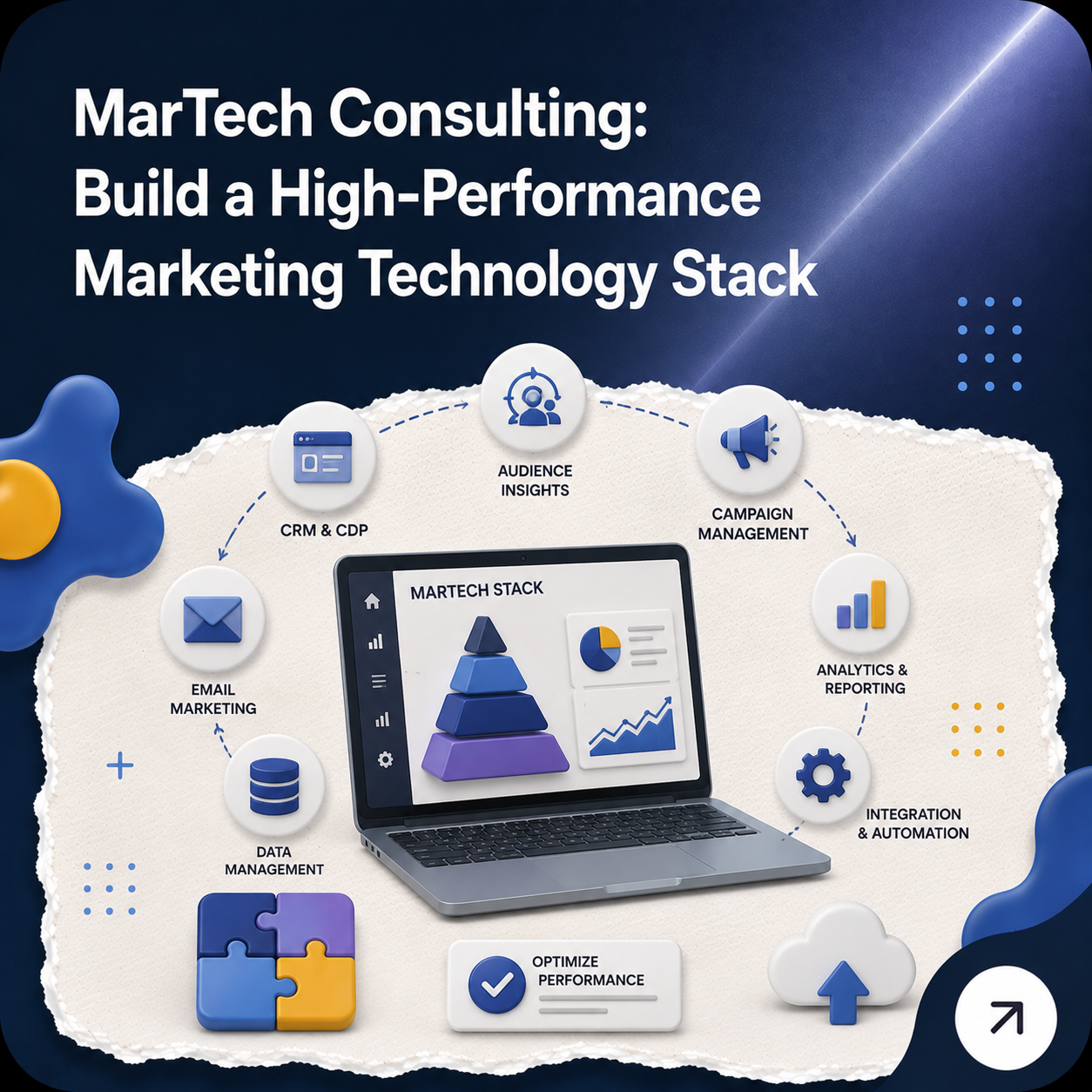
A B2B MarTech stack is the collection of platforms, technologies, and systems that support the entire customer lifecycle, from attracting prospects to nurturing leads, enabling sales, and retaining customers.
Rather than investing in dozens of disconnected platforms, businesses should build a technology ecosystem around their marketing objectives.
A modern B2B MarTech stack typically includes the following components:
| Layer | Purpose | Examples |
|---|---|---|
| Website & CMS | Digital presence and content management | WordPress, Webflow, HubSpot CMS |
| CRM | Customer and lead management | HubSpot CRM, Salesforce |
| Marketing Automation | Lead nurturing and campaign automation | HubSpot, Marketo, ActiveCampaign |
| Analytics | Measure marketing performance | Google Analytics 4, Looker Studio |
| SEO | Organic search visibility | SEMrush, Ahrefs |
| Paid Advertising | Lead acquisition | Google Ads, LinkedIn Ads, Meta Ads |
| Customer Data | Unified customer insights | Customer Data Platforms (CDPs) |
| AI & Automation | Workflow optimization and productivity | OpenAI, n8n, Zapier, Make |
The goal isn’t to own every available platform.
The goal is to ensure every platform contributes towards measurable business outcomes.
Five Principles of an Effective B2B MarTech Stack
Technology should simplify marketing – not complicate it.
Before implementing new platforms, organizations should evaluate whether their technology ecosystem follows these five principles.
1. Every Tool Should Solve a Business Problem
Technology should never be purchased because it’s popular.
Each platform should support a clearly defined business objective, whether that’s improving lead generation, automating customer journeys, or strengthening analytics.
Ask yourself:
- Does this tool replace an existing manual process?
- Will it improve customer experience?
- Can it generate measurable ROI?
If the answer is unclear, it may not belong in your stack.
2. Data Should Flow Seamlessly
A disconnected MarTech ecosystem creates fragmented customer experiences.
Your CRM, website, email platform, analytics, and advertising tools should continuously exchange information.
When systems communicate effectively, businesses gain:
- Better lead tracking
- Improved attribution
- Consistent customer experiences
- More accurate reporting
- Faster decision-making
This is where MarTech integrations become essential.
3. Automation Should Reduce Manual Work
Automation isn’t about replacing marketers.
It’s about eliminating repetitive tasks so marketing teams can focus on strategy, creativity, and optimization.
Examples include:
- Automated lead routing
- Personalized email journeys
- Campaign reporting
- CRM updates
- Lead scoring
- Internal notifications
- Customer onboarding
Well-designed automation improves productivity while reducing operational complexity.
4. AI Should Enhance Decision-Making
Artificial Intelligence has become an essential component of modern marketing.
However, AI delivers the greatest value when it complements human expertise rather than replacing it.
Organizations increasingly use AI for:
- Content ideation
- Audience segmentation
- Predictive analytics
- Workflow automation
- Campaign optimization
- Customer support
- Performance forecasting
A MarTech consultant helps identify where AI creates genuine business value without introducing unnecessary complexity.
5. Continuous Optimization Matters More Than Initial Implementation
Building a MarTech stack isn’t a one-time project.
Technology evolves.
Customer expectations change.
Marketing channels expand.
High-performing organizations regularly review their technology ecosystem to identify inefficiencies, improve workflows, and optimize platform usage.
Benefits of Effective MarTech Integrations
Organizations with integrated marketing ecosystems experience significant operational advantages.
These include:
- Improved customer experiences
- Faster campaign execution
- Better marketing attribution
- Reduced manual effort
- Higher data accuracy
- Improved collaboration between marketing and sales
- More informed business decisions
- Scalable marketing operations
Rather than managing disconnected technologies, teams operate from one connected ecosystem.
MarTech vs AdTech: What's the Difference?
The terms MarTech and AdTech are often used interchangeably.
While both support marketing initiatives, they serve different purposes.
Understanding the distinction helps businesses invest in the right technologies.
| MarTech | AdTech |
|---|---|
| Focuses on customer relationships | Focuses on advertising delivery |
| Supports the entire customer lifecycle | Primarily supports customer acquisition |
| Includes CRM, automation, analytics, CMS, email marketing | Includes DSPs, ad exchanges, SSPs, demand-side platforms |
| Helps retain and nurture customers | Helps reach new audiences |
| Owned primarily by marketing teams | Used by advertisers and media buying teams |
| Long-term customer engagement | Short-term campaign execution |
In Simple Terms
MarTech helps businesses build relationships.
AdTech helps businesses acquire attention.
The most successful organizations don’t choose one over the other – they combine both as part of a connected marketing strategy.
MarTech Cost Optimization Best Practices
Many organizations believe reducing technology costs means cancelling software subscriptions.
Effective MarTech cost optimization goes much deeper.
It’s about maximizing value while eliminating unnecessary complexity.
Below are some proven best practices.
1. Audit Your Existing Technology Stack
Begin by identifying:
- Duplicate platforms
- Underutilized software
- Expired workflows
- Redundant subscriptions
Many businesses discover they are paying for multiple tools with overlapping capabilities.
2. Consolidate Where Possible
Modern platforms often replace several standalone applications.
Instead of maintaining separate tools for:
- Email marketing
- CRM
- Landing pages
- Forms
- Reporting
Businesses may benefit from unified platforms that reduce costs while improving operational efficiency.
3. Prioritize Integrations Over New Purchases
Before investing in another platform, determine whether existing systems can be connected.
Improving MarTech integrations often delivers greater ROI than expanding the technology stack.
4. Automate High-Volume Tasks
Automation reduces operational costs by minimizing repetitive manual work.
Focus on automating:
- Lead assignment
- Customer follow-ups
- Campaign reporting
- Email nurturing
- Data synchronization
- Internal notifications
Automation improves consistency while allowing marketing teams to focus on strategic initiatives.
5. Measure Platform Utilization
Technology should be evaluated regularly.
Questions every organization should ask include:
- Which platforms generate measurable ROI?
- Which tools are rarely used?
- Are teams utilizing advanced features?
- Can multiple tools be consolidated?
- Are workflows performing efficiently?
Regular reviews ensure technology investments continue supporting business objectives.
Common MarTech Implementation Mistakes
Even with the right technology, businesses often struggle because of implementation challenges.
Some of the most common mistakes include:
- Purchasing technology before defining business goals.
- Selecting tools based on trends rather than business requirements.
- Ignoring data governance and integration planning.
- Failing to train teams on platform capabilities.
- Measuring platform adoption instead of business outcomes.
- Overcomplicating the technology stack with unnecessary software.
- Treating implementation as a one-time project instead of an ongoing optimization process.
Avoiding these mistakes allows organizations to unlock the full value of their MarTech investments while creating a more agile, scalable, and efficient marketing operation.
How to Choose the Right MarTech Consulting Partner
Selecting the right MarTech consulting partner is about more than finding a technology expert. The ideal partner should understand your business objectives, marketing operations, customer journey, and technology landscape, then build an ecosystem that supports long-term growth.
When evaluating a MarTech consulting partner, look for the following qualities:
Strategic Business Understanding
Technology should always support business outcomes. A strong consulting partner begins with your goals before recommending platforms or processes.
Expertise Across the MarTech Ecosystem
Your consultant should understand the complete marketing technology landscape, including CRM, marketing automation, analytics, AI, CMS, paid media, SEO, customer data, and workflow automation.
Integration Capabilities
Technology should work as one connected ecosystem. Ensure your consulting partner has experience designing and implementing seamless MarTech integrations.
Data-Driven Decision Making
Marketing decisions should be based on measurable insights rather than assumptions. A reliable MarTech consultant helps establish reporting frameworks, attribution models, and performance dashboards that guide strategic decisions.
Focus on Scalability
Your technology ecosystem should support future growth. The right partner designs solutions that evolve alongside your business rather than requiring constant reinvestment.
Continuous Optimization
Marketing technology is never “finished.” Continuous audits, workflow improvements, automation enhancements, and platform optimization ensure your MarTech stack continues delivering value as your business grows.
MarTech Maturity Checklist
Use the following checklist to evaluate whether your organization is maximizing the value of its marketing technology investments.
✔ Your CRM is integrated with your marketing automation platform.
✔ Marketing and sales teams work from the same customer data.
✔ Customer journeys are automated rather than manually managed.
✔ Marketing performance is measured through unified dashboards.
✔ Your B2B MarTech stack supports every stage of the customer lifecycle.
✔ Data flows seamlessly between platforms through effective MarTech integrations.
✔ AI is used to improve productivity, personalization, and decision-making.
✔ Your technology investments are reviewed regularly using MarTech cost optimization best practices.
✔ Marketing technology decisions are aligned with business objectives.
✔ Technology enables your team to focus on strategy rather than repetitive operational tasks.
If you answered “No” to several of these statements, your business could benefit from a structured MarTech consulting strategy.
Final Thoughts
Marketing technology continues to evolve at an unprecedented pace.
Businesses now have access to powerful AI platforms, automation tools, advanced analytics, customer data platforms, and intelligent marketing solutions capable of transforming the way marketing teams operate.
However, technology alone doesn’t create competitive advantage.
The organizations achieving sustainable growth are those that align strategy, people, processes, and technology into one connected ecosystem.
That’s the real value of MarTech consulting.
Whether you’re building your first B2B MarTech stack, improving MarTech integrations, evaluating MarTech services, or implementing MarTech cost optimization best practices, success depends on building a technology foundation that supports both current performance and future growth.
Rather than asking, “Which marketing tool should we buy next?”, forward-thinking organizations are asking a more important question:
“How can our entire marketing ecosystem work together to drive better business outcomes?”
The answer lies not in adding more technology – but in building a smarter, more connected marketing operation.
How IMS nHance Helps Businesses Build Smarter MarTech Ecosystems
At IMS nHance, we believe that successful marketing isn’t powered by technology alone—it’s powered by the right combination of strategy, AI, automation, data, and experienced marketing professionals.
Our MarTech consulting approach helps businesses:
- Design scalable marketing technology ecosystems
- Improve MarTech integrations across platforms
- Optimize existing marketing technology investments
- Implement automation that improves operational efficiency
- Build high-performing B2B MarTech stacks
- Align marketing technology with measurable business objectives
Whether you’re modernizing your marketing operations or planning your next phase of digital growth, our team helps transform disconnected marketing tools into an integrated ecosystem built for long-term success.
Ready to build a smarter marketing technology ecosystem?
Book a Discovery Call with IMS nHance and explore how our MarTech consulting expertise can help your business scale with confidence.