What Performance Marketing Actually Is (And What It Is Not)
Performance marketing is any marketing activity where spend is directly tied to a measurable outcome: a click, a lead, a sale, a download, a sign-up. Paid search, paid social, affiliate marketing, and programmatic display all fall under this umbrella when they are bought and optimized on a cost-per-result basis.
What performance marketing is not: a guarantee of profitable scale. Performance channels operate on existing demand. They capture intent that already exists. They convert audiences that are already primed to act. The moment you stop spending, the results stop. There is no residual asset being built.
This is not a criticism of performance marketing. It is a structural description of how it works. Understanding the mechanism is what allows you to deploy it strategically rather than reactively.
What Brand Marketing Actually Is (And What It Is Not)
Brand marketing is the investment in making your product, service, or agency the default choice before the purchase decision begins. It operates on attention, association, and memory: the reason a buyer shortlists you without consciously knowing why, the reason your paid ads convert better than a competitor’s, and the reason your clients stay longer and refer more often.
What brand marketing is not: unaccountable spending on awareness with no path to revenue. Modern brand marketing, including content strategy, thought leadership, organic social, and owned media, produces measurable outputs. They just operate on a different time horizon than a paid search campaign.
The distinction matters because conflating unaccountable brand spending with brand marketing is how the debate gets poisoned. Good brand marketing is not opposed to measurement. It requires different measurement frameworks.
Where the Debate Goes Wrong
The performance vs brand framing breaks down for three specific reasons.
1. Performance channels depend on brand equity to work
Click-through rates, quality scores, and conversion rates on performance channels are all partially a function of brand recognition. An ad from a brand a buyer already knows converts at a meaningfully higher rate than an identical ad from an unknown brand. Performance efficiency is downstream of brand investment. Running performance without brand is running on borrowed time.
2. Brand marketing produces performance outcomes
Content that ranks for informational queries generates organic traffic that converts. Thought leadership content that an agency’s prospects have read shortens the sales cycle and improves close rates. These are performance outcomes. They just arrive through brand channels. The performance vs brand marketing divide is artificial at the output level.
3. The debate is often a proxy for short-term vs long-term thinking
When marketing budgets are under pressure, performance channels look more defensible because outcomes are immediate and attributable. Brand investment looks riskier because the payoff is deferred. This is a reporting and accountability problem, not a marketing strategy problem. The companies that cut brand to protect performance metrics in the short term typically see performance efficiency decline within 12 to 18 months.
Brands that maintained brand investment alongside performance marketing during economic downturns recovered market share 9x faster than those that cut brand spend. Source: Analytic Partners, ROI Genome Report, 2022
The Data on Running Both Together
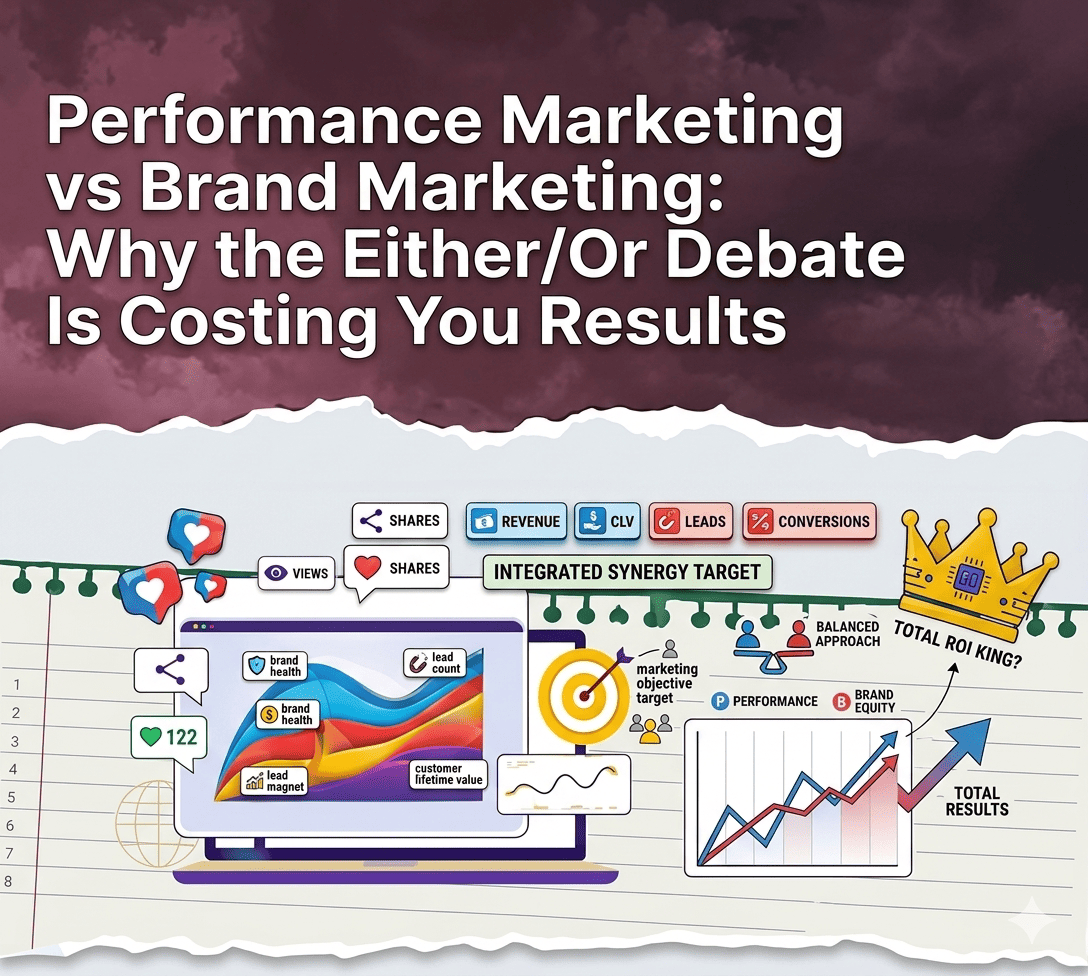
The research on integrated brand and performance strategies is consistent. Binet and Field’s long-running work on marketing effectiveness shows that the optimal split for most categories sits around 60% brand to 40% activation (performance), though this ratio shifts based on category maturity, competitive intensity, and business stage.
The key insight is not the exact ratio. It is that both functions are required, and that the payoff from each is amplified when the other is running. Brand investment makes performance more efficient. Performance investment generates the short-term returns that fund brand investment. They are not competing for the same outcomes. They are producing different outputs on different timelines, both of which are necessary for sustainable growth.
Dimension | Performance Marketing | Brand Marketing |
Time horizon | Immediate | Medium to long-term |
What it builds | Conversions | Preference and trust |
What it captures | Existing demand | Creates future demand |
Attribution | Direct and traceable | Indirect and modeled |
What happens if you stop | Results stop | Residual effect continues |
Metric focus | CPA, ROAS, CVR | Awareness, consideration, NPS |
Full Funnel Marketing Strategy: How Integration Works in Practice
A full funnel marketing strategy does not mean running brand and performance in parallel and hoping they interact. It means designing the customer journey so that brand touchpoints prime the audience for performance channels, and performance data informs brand positioning.
In practice, this looks like:
- Top of funnel: Content that answers the questions your audience is asking before they are ready to buy. This builds search presence, establishes authority, and populates your retargeting pools with a qualified audience.
- Mid funnel: Retargeting and email nurture that moves warm audiences toward a decision. This is where performance and brand overlap most directly: the brand equity built at the top of the funnel makes mid-funnel performance more efficient.
- Bottom of funnel: Performance channels operating at their best because they are talking to an audience that already knows who you are. Cost per acquisition drops. Conversion rates improve. ROAS goes up.
The funnel is not new. The discipline required to run it properly, with coordinated investment across all three stages, is rarer than most agencies will admit.
Performance Marketing Examples Done Right
The performance marketing examples that produce the best results share a common characteristic: they are not operating in isolation. They sit inside a broader marketing architecture that has done brand work upstream.
Consider a B2B agency running paid search for lead generation. The campaigns that convert most efficiently are targeting searches from buyers who have already encountered the brand through content, LinkedIn, or referral. The cost per lead is lower because the click-through rate is higher and the sales cycle is shorter.
Compare this to the same agency running paid search cold, with no prior brand exposure. The ads convert, but at a higher CPA and with a longer post-click nurture requirement. The performance numbers look similar on a campaign dashboard. The unit economics tell a different story.
The performance marketing KPIs being reported are the same in both cases. The underlying efficiency is not. This is why reporting on performance channel metrics without accounting for the brand environment those channels are operating in produces misleading conclusions.
Performance Marketing Metrics That Brand Teams Should Actually Care About
Brand teams often dismiss performance data as short-termist. Performance teams often treat brand metrics as unaccountable. The metrics that bridge this gap are the ones that show how brand investment is changing performance efficiency over time.
- Branded search volume: An increase in branded searches is a direct signal of brand awareness growth and is measurable through any search analytics platform.
- Direct traffic volume: Rising direct traffic indicates that more buyers are seeking you out without being prompted by a paid channel. This is brand awareness made measurable.
- Conversion rate by traffic source: If organic and direct traffic converts at a higher rate than paid traffic, that is evidence of the brand premium in action.
- Cost per acquisition trend over time: If CPA is declining while brand investment is increasing, you have evidence of the efficiency effect. If CPA is flat or rising, you need to understand why.
- Time to close by lead source: Leads who have consumed brand content before converting typically close faster and at better margins. Tracking this source-by-source reveals the real value of brand investment.
What Agencies Get Wrong When Running Both
The most common failure mode is not choosing the wrong strategy. It is running both strategies from separate teams with separate briefs, separate metrics, and separate reporting lines, and then wondering why the results do not compound.
Performance teams that do not understand what brand content has been running cannot optimize their messaging to match the positioning. Brand teams that do not look at performance data cannot identify which content angles are actually driving commercial intent. The two functions need a shared brief, shared audience data, and at minimum a weekly conversation.
The second failure is treating brand and performance as sequential rather than concurrent. Brand first, then performance, is a legacy planning model built for a world where the two channels were genuinely separate. In a digital environment where a buyer can encounter both in the same session, they need to be running simultaneously with consistent messaging.
How IMS nHance Supports Integrated Brand and Performance Delivery
IMS nHance works with agencies that need to deliver coordinated brand and performance marketing for their clients without building separate specialist teams for each function. We provide white label delivery across content strategy, SEO, paid media, and performance marketing, designed to operate as a unified delivery architecture rather than a set of disconnected services.
If your agency is managing clients who are stuck in the performance vs brand debate, we can help you build the case for integration and deliver the execution behind it. The conversation starts with understanding what your clients are currently measuring and what they are not.
Conclusion
The performance marketing vs brand marketing debate has an answer, and it is not a compromise. It is a recognition that the two functions are structurally complementary, not competing. Performance marketing captures demand. Brand marketing creates it. Neither works as well without the other, and the data consistently shows that running both together outperforms running either alone.
The agencies that are winning for their clients are not the ones that have resolved the debate. They are the ones that have moved past it.
Stop choosing between brand and performance. Start building the architecture that runs both. Talk to IMS nHance.