The most common complaint in B2B marketing is a version of the same problem: campaigns generate leads, but the leads don’t convert. Marketing reports a strong CPL. Sales reports a weak pipeline. Revenue doesn’t grow. And nobody can agree on whose problem it is.
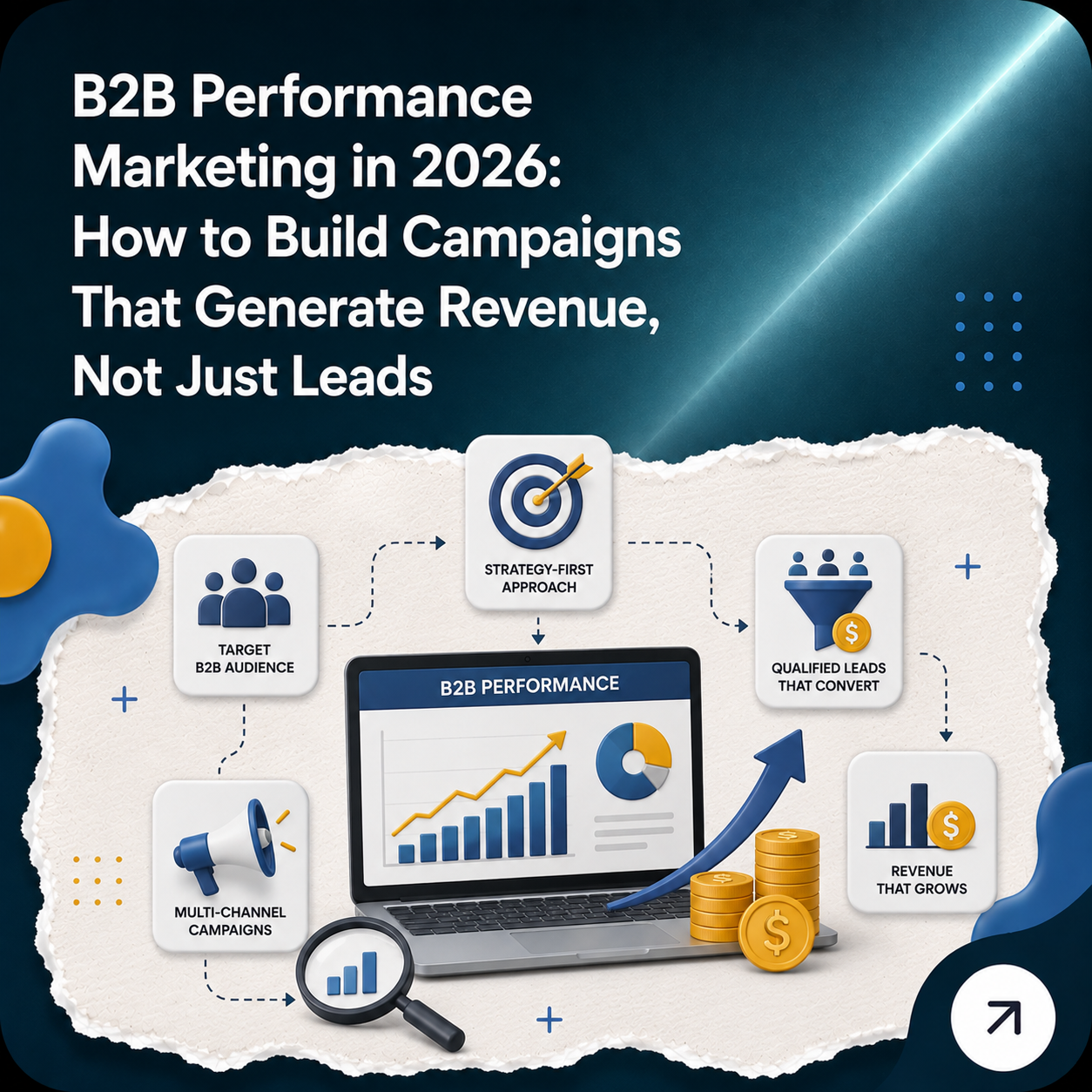
B2B performance marketing in 2026 is not about optimizing for more leads. It is about building campaigns that are connected to revenue outcomes – not just contact acquisition – from the moment strategy is set.
This requires a different approach to audience targeting, conversion tracking, campaign architecture, and the relationship between demand generation and lead generation. This guide covers what that approach looks like in practice.
Why Most B2B Performance Marketing Generates Activity, Not Revenue
The root cause of underperforming B2B campaigns is almost always a measurement problem. When campaigns are optimized for lead volume, the incentive is to maximize the number of people who complete a form – regardless of whether those people can buy, have authority to buy, or have a problem your product solves.
The result is a full CRM and an empty pipeline. Marketing celebrates a record CPL quarter. Sales spends weeks working through contacts that were never genuinely qualified. Revenue misses the target. The cycle repeats.
Only 27% of B2B leads generated by marketing campaigns are qualified enough to be passed directly to sales. The average B2B sales cycle lengthened by 22% between 2022 and 2025 as buying committees grew in size and risk scrutiny increased.
The fix is not a better lead nurture sequence. It is rebuilding the campaign strategy around revenue inputs – deal size, pipeline stage progression, close rate by source, and customer lifetime value – rather than around activity metrics like CPL and lead volume.
Demand Generation vs. Lead Generation: The Strategic Distinction
The B2B demand generation vs. lead generation distinction is one of the most practically important in B2B marketing strategy, and it is frequently confused.
Dimension | Demand Generation | Lead Generation |
Goal | Create awareness and intent in-market buyers | Capture contact information from potential buyers |
Primary metric | Pipeline influenced, brand recall, intent signals | Lead volume, CPL, form completions |
Time horizon | Long-term (6–18 months) | Short-term (immediate) |
Content approach | Ungated, high-value, educational | Gated, offer-driven, exchange-based |
Audience | Total addressable market | Current intent / bottom-funnel |
Revenue connection | Pipeline quality, close rate | MQL volume, sales acceptance rate |
Neither approach is wrong. The problem is running only one of them. B2B performance marketing campaigns that generate revenue invest in both – demand generation to build awareness and intent in the total addressable market, and lead generation to capture buyers who are already in-market.
The B2B Campaign Architecture That Connects to Revenue
A revenue-connected B2B campaign architecture operates across three stages, each with distinct objectives, metrics, and content requirements:
Stage 1: Awareness and Intent Building (Top of Funnel)
Objective: Make your brand known and trusted by in-market buyers before they are actively looking for a solution. At this stage, most of your target audience is not actively buying – but they will be within 6 to 18 months. Investment here determines whether your brand is on the short-list when they do enter the market.
What works at this stage: thought leadership content distributed through LinkedIn, industry publications, podcast advertising, and content syndication. Measurement: brand recall lift, content engagement, share of voice, target account reach.
Stage 2: Consideration and Nurture (Middle of Funnel)
Objective: Move in-market buyers who are aware of your brand through the evaluation process by demonstrating that your solution fits their specific situation. At this stage, buyers are comparing options, gathering stakeholder buy-in, and building internal business cases.
What works at this stage: case studies, ROI calculators, comparison content, webinars, and personalized nurture sequences triggered by intent signals. Measurement: MQL to SQL conversion rate, content engagement by account, pipeline influenced.
Stage 3: Conversion and Pipeline (Bottom of Funnel)
Objective: Convert qualified opportunities into pipeline and close revenue. At this stage, the sales team is primary and marketing’s role is to support the deal – reducing friction, providing social proof, and maintaining engagement across the full buying committee.
What works at this stage: targeted retargeting to known accounts, personalized outreach sequences, proposal support content, and reference customer programs. Measurement: pipeline stage progression, deal velocity, close rate by source.
B2B Performance Marketing Funnel: Revenue-Connected Campaign Architecture | |||
Stage | Objective | Key Tactics | Revenue Metric |
Awareness (ToFu) | Build brand recognition in ICP | LinkedIn content, thought leadership, podcast ads | Brand recall, target account reach |
Consideration (MoFu) | Move in-market buyers through evaluation | Case studies, webinars, ROI tools, nurture sequences | MQL→SQL rate, pipeline influenced |
Conversion (BoFu) | Convert qualified opportunities to revenue | Account retargeting, sales support content | Deal velocity, close rate by source |
Targeting Strategy: Reaching the Full Buying Committee
One of the most significant failures in B2B performance marketing campaigns is targeting only the end user or only the economic buyer. In most B2B purchases, the decision involves multiple stakeholders – champions, economic buyers, technical evaluators, and legal or procurement – each with different concerns and different content needs.
Ideal Customer Profile (ICP) definition
Before campaign targeting can be effective, your ICP needs to be defined at the account level: firmographic (industry, company size, geography, revenue), technographic (tech stack, platform signals), and behavioral (intent signals, engagement history). Account-level targeting is more precise and more relevant than contact-level targeting alone.
Persona-level content mapping
Each stakeholder in the buying committee has different questions, different objections, and different success criteria. A champion cares about adoption and implementation. An economic buyer cares about ROI and risk. A technical evaluator cares about integration and security. Content that speaks to all three in generic terms speaks effectively to none of them.
LinkedIn and account-based targeting
LinkedIn’s Matched Audiences feature and Company Targeting capabilities make it the primary channel for precise account-based targeting in B2B performance marketing. The ability to target by job title, seniority, company, and LinkedIn Group membership – and to layer that with Matched Audiences built from your CRM – allows campaign precision that is difficult to replicate on other platforms.
Conversion and Attribution in B2B
B2B conversion tracking is more complex than B2C because the customer journey is longer, involves multiple stakeholders, and may include both online and offline touchpoints. Standard last-click attribution models are particularly misleading in B2B contexts, where the conversion event (a demo request or form fill) may come 6 to 12 months after the first brand exposure.
The most important attribution shift for B2B is moving from contact-level to account-level measurement. Track which accounts are engaging with content, at what stages of the funnel, and over what time period — rather than focusing solely on individual lead conversions.
Key B2B conversion metrics to track:
- MQL to SQL conversion rate by source (which channels produce the highest-quality leads)
- Pipeline contribution by channel (how much revenue is in the pipeline that was touched by each channel)
- Deal velocity by source (how much faster do deals close that came through specific channels)
- Close rate by source (what percentage of MQLs from each channel ultimately close)
- Customer lifetime value by acquisition channel (which channels attract the highest-value customers)
Channel Strategy for B2B Performance Marketing in 2026
LinkedIn Advertising
LinkedIn remains the primary paid channel for B2B demand generation and lead generation. Thought Leader Ads, Conversation Ads, and Document Ads all support different stages of the funnel. The most effective B2B LinkedIn campaigns in 2026 combine awareness-stage content (ungated, high-value) with retargeting campaigns that serve bottom-funnel offers to engaged audiences.
Paid Search
Google Search captures in-market demand – buyers who are actively researching solutions. For B2B, the keyword intent signals are often problem-oriented rather than solution-oriented. Bidding on problem-framing queries (“how to reduce customer churn,” “B2B lead qualification process”) at the awareness stage and solution queries (“B2B CRM software,” “demand generation platform”) at the consideration stage covers the full intent curve.
Content and SEO
Organic search and content marketing operate at a longer time horizon but generate pipeline at significantly lower cost per acquisition than paid channels over time. A B2B content strategy that covers the full funnel – from educational thought leadership to comparison and evaluation content – creates an always-on demand generation asset that compounds with investment.
Email and Marketing Automation
Intent-triggered nurture sequences – based on content engagement, website behavior, or CRM stage – remain one of the highest-ROI tactics in B2B marketing. The key shift in 2026 is moving from time-based nurture sequences (“send this email 7 days after signup”) to behavior-triggered sequences that respond to what prospects actually engage with.
How to Measure B2B Campaign Performance Against Revenue
The measurement framework that connects B2B performance marketing to revenue outcomes requires data from both marketing and CRM systems. The core metrics:
Funnel Stage | Marketing Metric | Revenue Metric |
Awareness | Target account reach, impressions, brand recall | ICP accounts in pipeline |
Consideration | MQL volume, content engagement, webinar attendance | MQL→SQL rate, pipeline influenced |
Conversion | Demo requests, trial signups, sales-accepted leads | Close rate, deal velocity, pipeline value |
Retention | Product engagement, NPS, upsell signals | Expansion revenue, LTV, churn rate |
How IMS nHance Supports B2B Performance Marketing
IMS nHance works with marketing agencies and enterprise marketing teams running B2B performance marketing campaigns – from demand generation strategy and content creation to paid media management and performance reporting.
Our B2B work covers the full campaign architecture: ICP definition and audience targeting, full-funnel content development, paid search and LinkedIn campaign management, lead nurture sequences, and the measurement framework that connects campaign activity to pipeline and revenue outcomes.
Conclusion
B2B performance marketing that generates revenue rather than just leads requires a fundamental shift in how campaigns are designed, measured, and optimized. The shift is from optimizing for activity metrics (lead volume, CPL) to optimizing for revenue inputs (pipeline quality, deal velocity, close rate by source).
This means investing in both demand generation and lead generation, building campaigns that speak to the full buying committee, implementing attribution models that reflect the length and complexity of B2B buying cycles, and measuring performance against pipeline and revenue outcomes rather than form fills.
The campaigns that generate revenue in 2026 are the ones that were designed to generate revenue from the first strategy session – not the ones that generate leads and hope the rest follows.
Ready to build B2B campaigns that connect to revenue? Get in touch with one of our experts to enable B2B Performance.