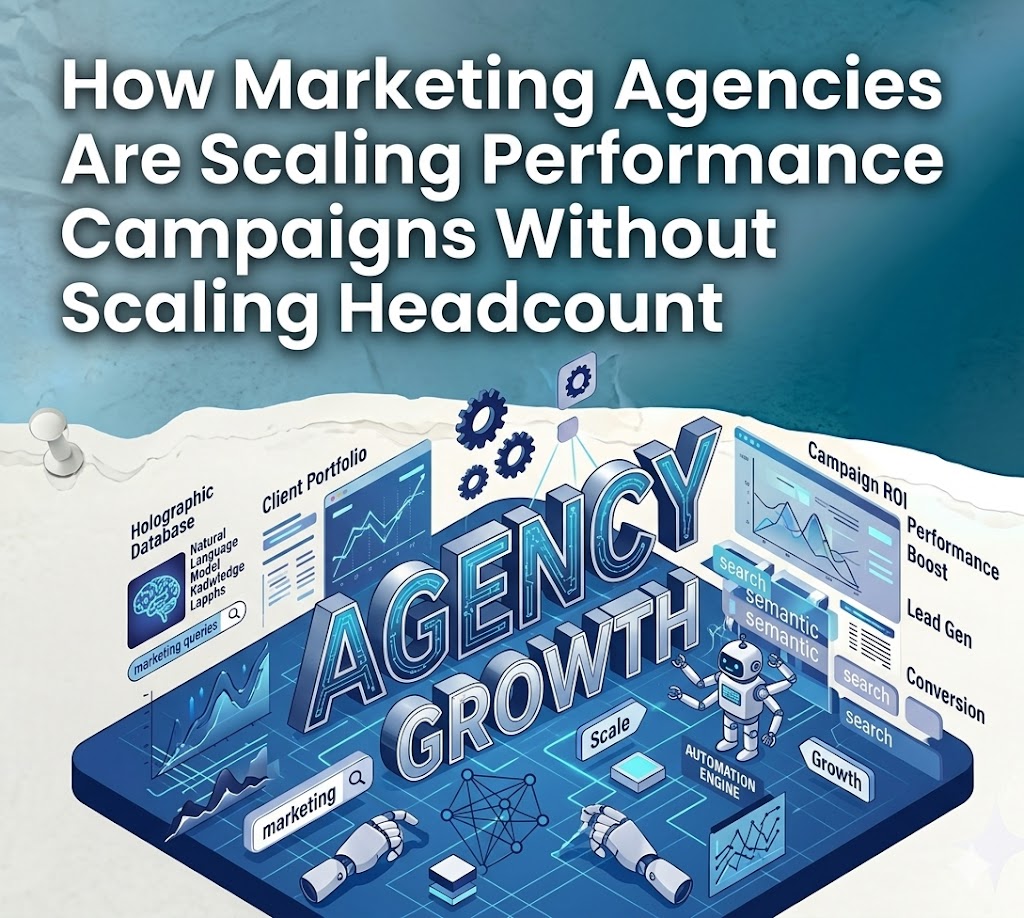
Winning new performance marketing clients used to mean one thing: hiring.
More clients meant more campaigns. More campaigns meant more campaign managers, more analysts, more reporting hours, and more overhead. The revenue grew, but so did the cost structure, the coordination complexity, and the delivery risk. For most agencies, headcount and campaign volume moved together like they were fixed to the same lever.
They are not. And the agencies that have figured this out are operating at a meaningfully different margin than those that have not.
This is not about automation replacing human judgement. It is about understanding which parts of performance campaign delivery require scarce, strategic thinking, and which parts can be handled through smarter resourcing, white label delivery, and process design. The difference determines how a marketing agency grows, and how profitably it does it.
The Headcount Trap in Performance Marketing
Performance marketing is operationally intensive. Paid search campaigns require ongoing keyword management, bid strategy, ad copy testing, and Quality Score maintenance. Paid social campaigns require creative rotation, audience segmentation, and platform-specific optimization. Analytics require clean data infrastructure, attribution modeling, and reporting that someone has to produce every single week.
Each new client adds volume to every one of these operational layers. And because performance marketing is measurable in near-real-time, the tolerance for delivery gaps is low. Clients notice when campaigns are not being actively managed. The pressure to add headcount in response to new business is real.
The trap is treating every new unit of campaign volume as requiring a proportional increase in internal resource. It does not. But escaping it requires designing the delivery model before the growth happens, not in response to it.
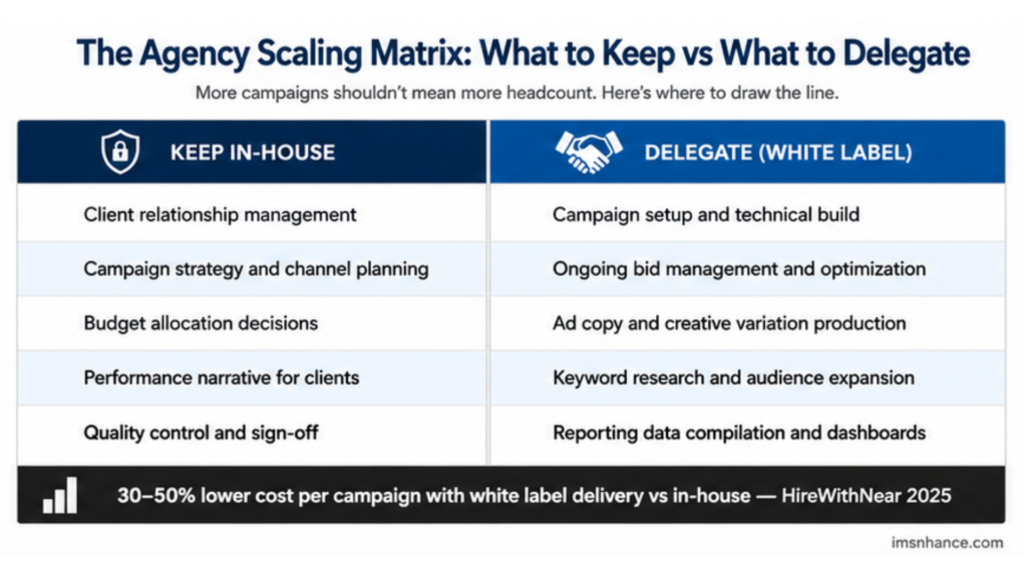
Agencies using outsourced or white label performance delivery report 30 to 50% lower cost per campaign managed compared to equivalent in-house teams, with the gap widest for paid search and programmatic. Source: HireWithNear, Agency Outsourcing Benchmark 2025
What Actually Scales in a Performance Marketing Operation
Not all parts of performance campaign delivery are equally difficult to scale. Understanding the distinction is the starting point for building a scalable delivery model.
High strategic value / hard to scale externally:
- Client relationship management and strategic counsel.
- Campaign strategy and channel planning.
- Budget allocation decisions and performance narrative.
- Client-facing reporting interpretation and recommendations.
Operationally intensive / scales well with the right partner:
- Campaign setup and technical build.
- Ongoing bid management and optimization execution.
- Ad copy and creative variation production.
- Keyword research and audience expansion.
- Reporting data compilation and dashboard maintenance.
The first category is what your senior team should be doing. The second category is where most of the hours go. The question is not whether to resource the second category. It is where that resource comes from.
White Label PPC Management: The Delivery Architecture Most Agencies Are Using
White label PPC management means that the campaign operations, setup, optimization, and reporting for a client’s paid search or paid social activity are handled by a specialist third party, delivered entirely under your agency’s brand. Your client sees your name on the work. They have no visibility of the provider.
This is not a new model. It is how a significant share of performance marketing is already delivered across the agency market. The question is not whether it works. It is how to implement it without compromising the quality your clients receive.
The agencies that do this well maintain three things in-house: the client relationship, the strategic brief, and the quality standard. Everything else can be accessed through a white label partner without the client experience suffering. In many cases, it improves, because the specialist delivering the work does nothing else.
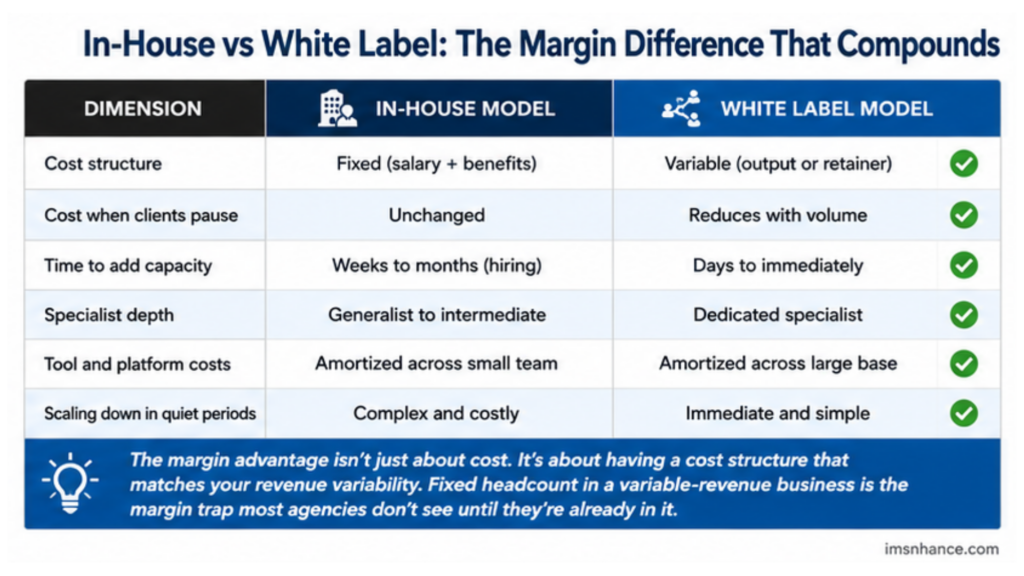
Model | In-House | White Label |
Cost per campaign managed | Fixed overhead + benefits | Variable, output-based |
Time to add campaign capacity | Weeks to months (hiring) | Days to immediately |
Specialist depth | Generalist to intermediate | Specialist and dedicated |
Scaling down in quiet periods | Complex and costly | Simple and immediate |
Confidentiality | N/A | Covered by NDA |
How to Scale a Marketing Agency Without Proportional Hiring
Scaling a marketing agency without proportional headcount growth requires a different mental model for what an agency actually is. The traditional model is an agency as a team: a group of people who deliver services directly. The scalable model is an agency as a delivery architecture: a client-facing layer with strategic and relationship functions, supported by a delivery layer that can scale up or down without changing the fixed cost base.
This is how the best-performing independent agencies operate. They maintain a lean senior team with deep client relationships and strong strategic capability. They access delivery capacity through partners rather than employees for services where specialist depth matters more than in-house ownership. And they build their margin into the architecture rather than hoping it survives headcount growth.
The practical steps:
- Audit your delivery hours. Identify which activities consume the most time and produce the most client-visible value. The mismatch between these two lists is where the opportunity sits.
- Identify which services are core differentiators. These stay in-house. Services that are necessary but not differentiating are candidates for white label delivery.
- Design the white label delivery brief. Quality in outsourced delivery is a function of the brief. Clear quality standards, brand voice guidelines, and output formats produce client-ready work. Vague briefs produce generic work.
- Build the client-facing layer. Your account team manages the relationship, owns the strategy, and presents the work. The white label partner delivers it. The client experience is seamless.
White Label Digital Marketing Services: What to Delegate and What to Keep
White label digital marketing services span a wide range of functions. Not all of them are equally appropriate for external delivery. The decision framework is straightforward: keep what your clients specifically chose you for. Delegate everything else that can be delivered to the same standard through a specialist partner.
Service | Delegate or Keep? | Notes |
Paid search campaign management | Delegate | High operational intensity, scales well externally |
Paid social creative strategy | Keep | Requires deep client brand knowledge |
Paid social execution and optimization | Delegate | Operational, repeatable, specialist-dependent |
Analytics setup and reporting | Delegate | Tool-intensive, benefits from specialist depth |
Performance narrative and client comms | Keep | Strategic, relationship-dependent |
Keyword research and expansion | Delegate | Time-intensive, tools-dependent |
Campaign strategy and budget planning | Keep | Core agency value proposition |
White label performance marketing reporting | Delegate | Specialist providers do this at scale |
The Margin Arithmetic of Outsourced Performance Delivery
The case for white label performance delivery is not just operational. It is economic. The arithmetic is straightforward when you work through it.
An in-house campaign manager handling 8 to 12 clients at full capacity costs a fixed salary regardless of whether campaign volume is high or low that month. A white label delivery partner charges on output or retainer, which scales with your actual client volume. In a month where two clients pause campaigns, the in-house cost is unchanged. The white label cost reduces.
Across a portfolio of performance clients, this variable cost structure produces a meaningfully better margin profile than a headcount-heavy model, particularly in the early stages of agency growth when client volume is still volatile.
The second margin advantage is access to specialist expertise at a cost that would not be achievable in-house at equivalent volume. A specialist white label PPC team has amortized their tool costs, training costs, and process development costs across a large client base. You access that capability at a fraction of what it would cost to build it yourself.
What Agencies Get Wrong When They Try to Scale
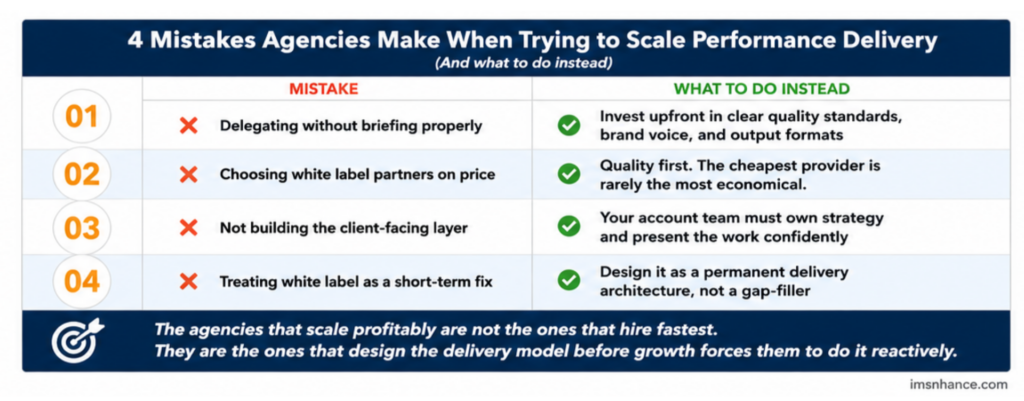
Delegating without briefing properly. White label delivery produces the output the brief specifies. If the brief is incomplete, the output will be generic. The quality control mechanism is the upfront investment in clear standards, not the revision process.
Choosing on price rather than on fit. The cheapest white label provider is rarely the most economical when you account for revision time, client escalation risk, and the senior hours required to fix substandard work. Quality first. Cost second.
Not designing the client-facing layer. White label works when the client-facing layer is strong. If your account team cannot competently interpret and present the work the partner delivers, the model breaks down. Invest in the front of the house as much as the back.
Treating it as a short-term fix rather than a permanent architecture. The agencies that benefit most from white label delivery treat it as a designed component of their service model, not a gap-filler. Build it into your delivery architecture from the start.
How IMS nHance Works with Agency Partners on Performance Scaling
IMS nHance provides white label performance marketing delivery, including PPC management, paid social execution, analytics and reporting, and content production, designed specifically for agencies that need to scale delivery without scaling headcount.
Every engagement is structured around your quality standards and your client’s deliverable requirements. All work is produced under your branding with full confidentiality. We operate as an extension of your delivery team, not a vendor your clients will ever encounter.
Whether you are growing and need capacity immediately, or looking to restructure your delivery model for better margins, the conversation starts with understanding what you need delivered and what good looks like for your clients.
Conclusion
Scaling performance campaign delivery without scaling headcount is not a hack. It is a deliberate choice about how to structure a marketing agency for sustainable growth. The agencies that make this choice early build better margins, stronger delivery capability, and more flexibility to respond to client demand than those that default to hiring every time revenue grows.
The model requires a clear division between what you own and what you access. It requires investment in briefing quality and client-facing capability. And it requires a partner who delivers to the standard your clients expect.
If you are growing your performance marketing offer and need delivery capacity that scales with your clients, not against your margins, talk to subject matter experts at IMS nHance to know more.