Marketing operations are entering a decisive phase marked by structural change across teams, tools, and delivery models. Scale is no longer constrained by headcount, and speed is no longer achieved at the expense of quality. At the centre of this shift are intelligent execution systems designed to act with intent, context, and autonomy while remaining grounded in human judgment.
In 2026, outsourced marketing teams will not simply adopt to these models faster than in house teams. They will reshape how agency operations function, building execution environments that are adaptive, resilient, and consistently outcome-led. This evolution reflects a broader operational reset across the marketing ecosystem.
Understanding Agentic AI in Modern Marketing
To define agentic in a marketing context is to move beyond static automation and rule-based task execution. It refers to systems that can interpret context, set intermediate objectives, and adjust actions dynamically as conditions change.
A clearer picture reveals when viewed through operational outcomes rather than theory. An AI agent does not merely complete an assigned task, rather it evaluates signals, weighs constraints, and determines the most effective next step within a governed framework. As frameworks mature, execution morphs from manual handoffs to continuous orchestration that prioritises outcomes over activity.
What Are AI Agents and Why They Matter in Agency Operations
Questions regarding understanding the development of agentic processes continue to dominate broader agentic AI news cycles. Their relevance lies in how they change the flow of work, not just the tools used to complete it.
These conversations reflect a structural shift in how work progresses and are important in changing execution flow rather than introducing new tools.
Within agency environments, these systems span content development, SEO analysis, media optimisation, and performance reporting. They observe patterns, surface anomalies, and initiate actions that once required multiple manual coordination points.
Coordination across functions reduces operational friction across campaigns and channels. When orchestrated with clarity, these agents help forge systems that build momentum instead of paralysis, and that agile focus mirrors operational philosophies shared in Navigating the Meta Andromeda Update: Brand-Led Growth Through New-Age Digital Marketing Solutions.
Agentic Process Automation as the Backbone of Scalable Execution
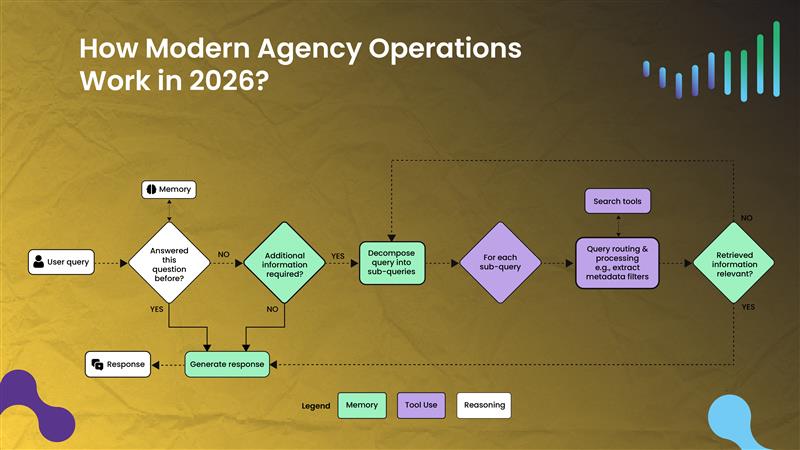
By automating the agentic process, agencies can introduce flexibility without compromising control. It enables workflows to adapt to performance signals while preserving governance and accountability across teams.
For outsourced marketing operations managing multiple clients, regions, and growth stages, this capability becomes foundational. Processes are structured with intent, refined through feedback, and scaled without fragmenting quality. Execution expands horizontally while standards remain consistent, reflecting a broader industry shift toward operational intelligence over linear delivery models.
Integrated solutions such as those featured on the IMS nHance Solutions showcase how structured frameworks support scalable outcomes.
Why Outsourced Marketing Teams Adopt Agentic Workflow Faster
Outsourced teams operate under structures that favour rapid adoption of adaptive execution models. Performance accountability, exposure to diverse industries, and continuous optimisation cycles create conditions where these systems deliver immediate operational value.
In-house teams often contend with approval latency, fragmented tooling, and rigid role boundaries. Outsource partners, by contrast, are built for velocity as they refine systems across engagements, apply learnings at scale, and treat workflow maturity as a competitive advantage. This structural reality accelerates adoption without compromising governance.
For teams exploring advanced operating models, insights from Strategic Horizons 2026: The Future of Outsourced Marketing Services reinforce why execution-centric design matters.
How Agentic Processes Transform Day-to-Day Agency Operations
The transformation is practical and visible across daily execution. It reshapes how marketing functions operate under real-world constraints.
Content workflows shift from linear production to responsive systems, with briefs evolving continuously based on performance data. SEO operations integrate intent analysis, internal linking logic, and diagnostic monitoring without requiring constant manual oversight. Campaign management is strengthened by autonomous monitoring that flags inefficiencies early, before they escalate into measurable performance losses.
Together, these changes reflect a broader move toward adaptive execution, where systems respond to volatility faster and more consistently than static strategies can accommodate.
How AI Agents Will Change Research and Strategic Planning
One of the most underestimated impacts of these systems lies in research. Their influence is already becoming evident within advanced agency models that are reshaping how insight is generated and applied.
AI agents bring together market signals, competitor activity, and audience behaviour at a scale and pace that manual analysis cannot match. They strengthen strategic thinking by providing planners with live intelligence rather than retrospective reports. This shift allows strategy to remain responsive, iterative, and grounded in evidence instead of assumptions.
The Human Layer in Agentic Process Automation
Despite their autonomy, these execution models are not independent silos. Human oversight remains essential to ensure relevance, accountability, and brand integrity.
Strategists define objectives and decision boundaries, while editors safeguard narrative nuance and contextual accuracy across channels. Analysts validate interpretations and outcomes against business intent, ensuring that intelligent systems operate with purpose rather than unchecked autonomy.
In mature implementations, these models function as multipliers of expertise. Judgment, ethics, and creativity remain firmly human-led, strengthened by systems designed to support informed decision-making rather than replace it.
What This Means for Brands Partnering with Outsourced Teams
For brands, the implications are tangible and measurable. Execution accelerates without eroding standards. Delivery remains consistent across channels. Scalability is achieved without reliance on perpetual hiring cycles.
Outsourced partners operating mature agentic workflows function as operational extensions of internal teams. Strategy, execution, and optimisation converge within a cohesive system, enabling brands to move beyond fragmented initiatives.
AI Agentic Models as the New Agency Operating System
By 2026, these execution models will no longer be experimental, rather they will be foundational to how modern agencies operate and compete in increasingly complex marketing environments.
As intelligent systems continue to mature and interoperable capabilities expand, the separation between planning and execution continues to narrow. What remains constant is the need for disciplined orchestration, strategic clarity, and accountable partnership.
Industry leaders, including IMS nHance, illustrate that when such models are implemented with intent and governance, they move beyond efficiency gains. They redefine how modern marketing work gets done, positioning agencies as long-term operational stewards rather than short-term service providers.