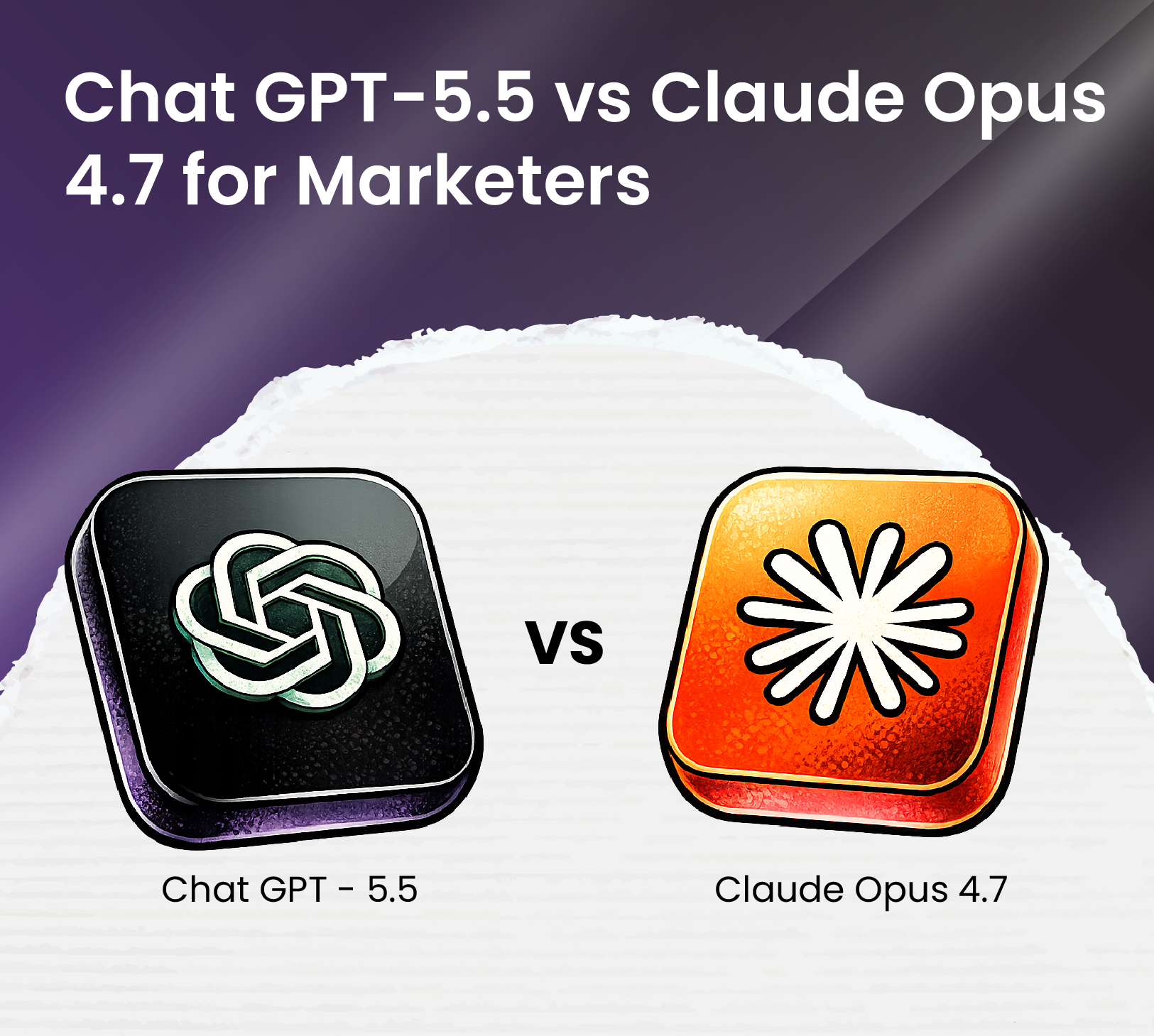
The last few weeks have been loud with takes on GPT-5.5 and Claude Opus 4.7. Both models dropped in April 2026 within seven days of each other; and the internet – predictably turned it into a horse race.
Most of the conversation has been dominated by developers and AI researchers benchmarking these models on coding tasks, agentic workflows, and terminal performance. That is a legitimate conversation – but it is not the conversation that matters most if you are a marketer, a marketing agency, or a brand trying to figure out which of these tools actually makes your day-to-day better
So here is our honest take – not from a lab benchmark, but from a marketing perspective. Where each model genuinely wins, where the hype oversimplifies things, and what it means for the way you work.
First – What Are We Actually Talking About?
GPT-5.5 is OpenAI’s latest flagship model, released April 23, 2026. It is designed primarily as an agentic work model – meaning it can take a complex goal, break it into steps, use tools, verify its own output, and complete multi-part tasks with minimal human hand-holding. It powers Codex, OpenAI’s AI agent platform, and is available to ChatGPT Plus, Pro, Business, and Enterprise subscribers.
Claude Opus 4.7 is Anthropic’s current flagship, released April 16, 2026. It is built for precision, reliability, and extended reasoning – particularly strong in long-form tasks, nuanced writing, and workflows where getting things factually right matters more than getting them done fast.
Where GPT-5.5 Wins for Marketers
Let’s start with the capabilities that are genuinely exciting from a marketing workflow perspective – ang GPT-5.5 has several of them.
Content repurposing at speed
One of the most practically useful demonstrations of GPT-5.5 for marketers is what it does with a YouTube link. Give it a long-form video and it will generate timestamped breakdowns – identifying exactly where the quotable moments, key insights, and short-form-ready clips are, down to the second. For a social media manager or content team building a repurposing workflow around video content, that is not a gimmick. That is hours of manual scrubbing compressed into minutes.
But, GPT-5.5 via Codex goes further. It can take those timestamps and generate the actual short-form video clips – vertically formatted, ready for Reels or Shorts – without you needing to open an editing tool. For marketing teams running high-frequency content operations, that capability alone reshapes what a lean team can produce.
Marketing dashboards and campaign packages
GPT-5.5 can build functional marketing dashboards – pulling data, structuring it visually, and presenting it in a format you can use for reporting or client presentations. It has also demonstrated the ability to produce complete marketing campaign packages: ad copy, visual concepts, project timelines, and channel breakdowns, all in one output.
For agencies managing multiple client accounts, the speed at which GPT-5.5 can get from brief to structured first deliverable is a genuine operational advantage. It is not always perfect – it occasionally produces formatting inconsistencies and requires refinement – but the baseline output quality is high enough to make it a serious production tool, not just a drafting aid.
Creative versatility
For creative writing, marketing content, and versatile prose, GPT-5.5 is the stronger choice. It handles tone variation well, moves fluidly across formats, and produces copy that feels genuinely written rather than generated. For high-volume content production – ad copy variations, email sequences, social captions – it is fast, flexible, and consistent enough to trust at volume.
Where Claude Opus 4.7 Wins for Marketers
The narrative that GPT-5.5 “won” the comparison misses something important — Claude Opus 4.7 is doing different things better, and for marketing work specifically, those things matter.
Accuracy and trust in long-form content
Claude Opus 4.7 is more cautious and more precise when accuracy matters. For research-heavy content – whitepapers, thought leadership pieces, technical blogs, compliance-adjacent marketing – Opus 4.7 is less likely to produce a confident-sounding claim that turns out to be wrong. It flags uncertainty more naturally, cross-references better, and produces long-form content that holds up under scrutiny.
For agencies working with clients in sectors where a factual error in a published piece has real consequences – finance, healthcare, legal, SaaS – that reliability is not a minor consideration. It is the difference between a tool you can trust for client-facing content and one you must watch carefully.
Strategic and nuanced writing
Where Claude Opus 4.7 quietly outperforms GPT-5.5 for marketers is in the kind of writing that requires sustained depth – strategy documents, brand positioning work, audience insight analysis, long-form editorial content. It thinks before it writes. It maintains coherence across long sessions without losing its thread. And it produces output that reads as considered rather than generated.
For marketing professionals whose output involves real intellectual substance – not just volume – that distinction is worth paying attention to.
Consistency and predictability
Claude Opus 4.7 produces more consistent output across repeated prompts with the same input – which matters more than it might sound for marketing operations. When you are running a content process that involves multiple team members, multiple clients, and multiple formats, a tool that behaves predictably is operationally easier to manage than one with higher creative variance. GPT-5.5’s variance can be a feature for creative tasks. For structured, systematic marketing production, it can also be a friction point.
The Honest Side-by-Side for Marketing Teams
Rather than declaring a winner, here is where each model actually earns its place in a marketing workflow:
Task | GPT-5.5 | Claude Opus 4.7 |
Ad copy & creative writing | Stronger | Good |
Long-form blog/ thought leadership | Good | Stronger |
Video content repurposing | Significantly stronger | Limited |
Marketing dashboards & reports | Stronger | Good |
Research-heavy / accuracy-critical content | Good | Stronger |
Email sequences at volume | Faster & more flexible | Good |
Brand strategy & positioning docs | Good | More nuanced |
Social media captions (high volume) | Stronger | Good |
Consistent output across team workflows | Good | More predictable |
Campaign packages (copy + concepts) | Stronger | Good |
What the "GPT-5.5 Won" Narrative Gets Wrong
The dominant narrative from the comparison – that GPT-5.5 won, and it wasn’t close – is fair when the evaluation criteria are agentic coding speed and terminal performance. GPT-5.5 is faster, more token-efficient, and better at autonomous multi-step technical workflows. On those metrics, the lead is real.
But marketing is not primarily a coding or terminal workflow. It is a communication and strategy discipline that involves nuance, accuracy, brand voice, audience understanding, and sustained depth of thought. On those criteria, Claude Opus 4.7 does not lose. In several areas, it wins comfortably.
The mistake is applying an engineering benchmark to a marketing decision. These are different tools for different job profiles – and a marketer who chooses based on the wrong benchmark ends up with a tool that excels at things they rarely need and falls short on things they do every day.
The Practical Recommendation
For most marketing teams and agencies, the right answer is not one or the other – it is knowing which tool to reach for based on what you are doing.
- Reach for GPT-5.5 when you need volume, speed, creative variety, video repurposing, dashboard generation, or campaign package production.
- Reach for Claude Opus 4.7 when you need accuracy, depth, brand consistency, strategic writing, or long-form content that will be scrutinised.
- For agencies managing multiple client accounts across both categories, having both available – and knowing which to deploy when – is what gives you a genuine operational edge.
The era of “which AI is best” is giving way to something more sophisticated: understanding what each tool actually does well and building your workflows around that knowledge rather than around the benchmark headlines.
Let Your Marketing Team Focus on Strategy. We'll Handle the Execution.
At IMS nHance, we work as an outsourced marketing team for agencies and brands that want senior marketing output without the overhead of building it all in-house. Our team works across content, SEO, paid media, social, and more – and we stay ahead of exactly the kind of shifts this article covers, so our clients don’t have to.
If you want a marketing team that understands both the tools and the strategy behind them, let’s talk.