There is a specific moment in the growth trajectory of almost every agency when the same question surfaces: do we hire for this, or do we partner for it?
It usually arrives under pressure. A new client win that requires a service you do not currently deliver at the quality you want. A key team member leaving at the worst possible time. A pricing conversation where you are losing on margin because your delivery costs have outpaced your rates. Or simply the slow accumulation of a workload that is starting to limit how well you can serve the clients you already have.
That is the moment when white label marketing services go from a concept to a decision. And for most agency owners, the decision is not whether to use them eventually. It is why they are waiting.
What White Label Marketing Services Actually Are
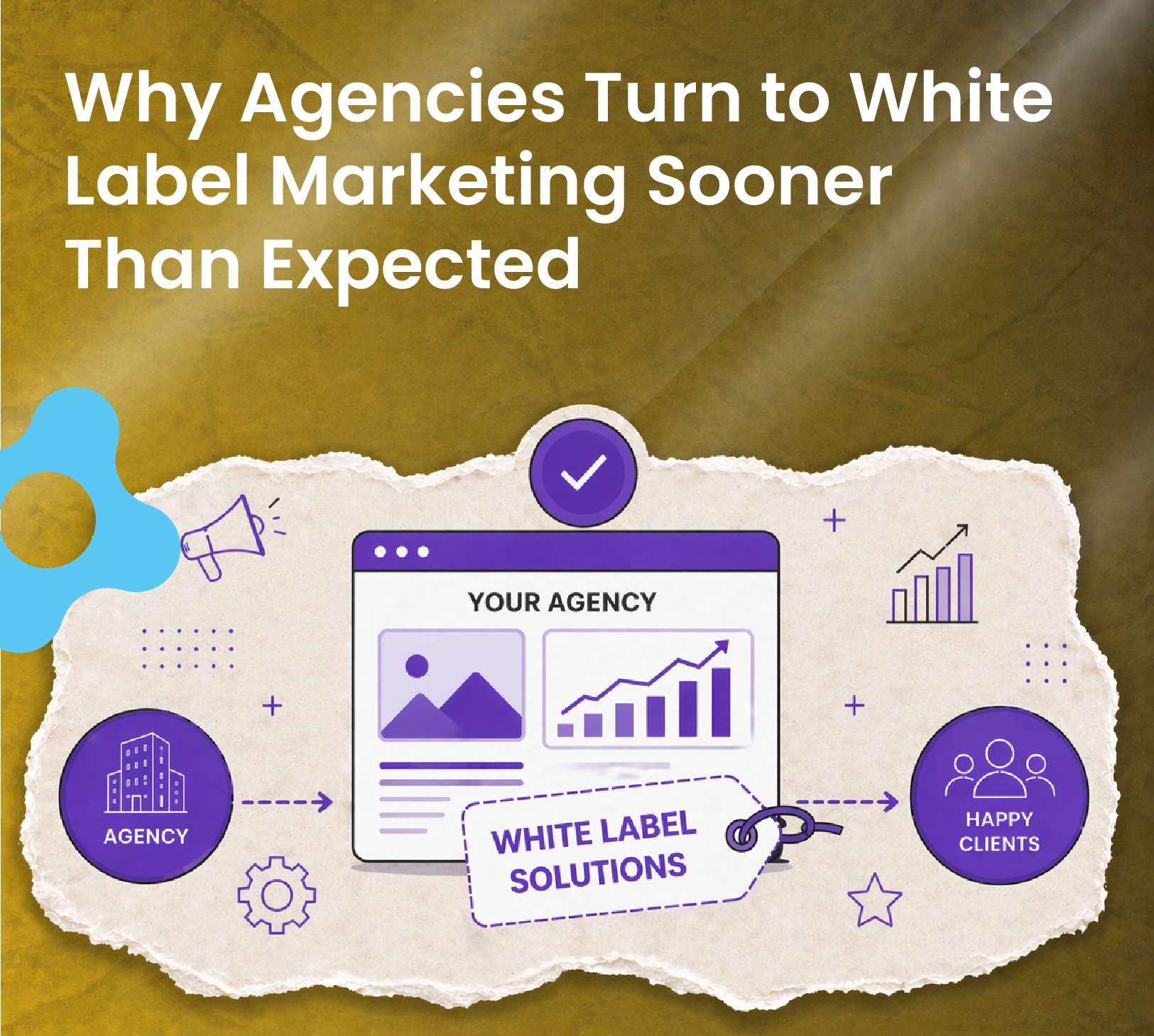
White label marketing services are services delivered by a specialist third-party provider but sold and presented to clients under your agency’s own brand. The client sees your name, your reports, and your account team. The provider works invisibly in the background.
The model is standard across most mature service industries. Restaurants use it for specialist menu items. Law firms use it for niche legal work. Accounting firms use it for specialist tax advice. In agency terms, it simply means that when a client asks for a service your team does not currently deliver, your answer is ‘yes’ rather than ‘not yet.’
What distinguishes white label agency services from simple outsourcing is the confidentiality layer. The provider never interacts with your client, never reveals their involvement, and delivers all work in a format you can present as your own. Your client relationship is protected throughout.
94% of marketing teams outsource at least part of their workload, with white label partnerships cited as the most common model for service expansion.
Source: ViralChilly / HubSpot Agency Benchmark Data, 2025
https://viralchilly.com/blog/benefits-of-white-label-seo-services
The Four Triggers That Lead Agencies to White Label
Trigger 1: The New Service Problem
You win a client who needs a service you do not currently deliver, or whose existing provider is your competitor and you want the whole relationship. You can build the capability in-house, but that takes months, and the client needs it now. You can decline the work, but that cedes ground to a competitor. Or you can outsource white label marketing and deliver the service under your brand from day one.
This is the most common first entry point into white label partnerships for growing agencies. It starts as a tactical fix: cover the gap, win the work, buy time to build in-house if the volume justifies it. For many services, particularly those requiring specialist skills, significant tool investments, or established publisher and network relationships, the in-house build never becomes economical. The white label arrangement becomes permanent, and margins improve over time as the volume scales.
- Common services first white labeled this way: white label SEO, PPC management, content production, link building, technical audits
Trigger 2: The Capacity Ceiling
Your team is delivering well but at full capacity. New business is available, but taking it on risks undermining the quality you are delivering to existing clients. Hiring solves the capacity problem but introduces fixed overhead, a recruitment cycle, and onboarding time, none of which are available in the timeframe that a new client opportunity requires.
White label marketing services solve the capacity problem with variable cost structure. You add delivery capacity immediately, pay for output rather than headcount, and scale back during quieter periods without the complexity of managing staff levels. For agencies in a growth phase where client volume fluctuates, this flexibility is operationally significant.
- The question to ask: if you won three new clients next month, could your current team deliver all three at the quality your existing clients receive? If the answer is no, you have a capacity ceiling that white label can solve.
Trigger 3: The Margin Squeeze
Your revenue is growing but your margins are not keeping pace. Delivery costs, tool subscriptions, and team overhead are consuming an increasing share of client fees. The economics of building and maintaining specialist capability in-house are working against you at your current scale.
This is where the cost advantage of white label digital marketing is most directly measurable. Specialist providers benefit from scale efficiencies: larger tool subscriptions spread across a larger client base, dedicated specialists whose entire focus is one discipline, and established processes that reduce the time cost per deliverable. Agencies typically access these efficiencies at a cost structure that preserves healthy margins, even after the provider’s fee.
Agencies using white label outsourcing report 30 to 70% lower delivery costs compared to equivalent in-house teams, with the gap widest for specialist services like link building, technical SEO, and paid media management.
Source: HireWithNear, SEO Outsourcing Statistics 2025
https://www.hirewithnear.com/blog/seo-outsourcing-statistics
Trigger 4: The Talent Gap
You need a specific capability that is genuinely difficult to hire for in your market: senior technical SEO expertise, specialist paid media management, native-language content production for a market you are expanding into. The talent exists, but finding, hiring, and retaining it is slow, expensive, and uncertain.
White label partnerships eliminate the hiring cycle entirely. You access the capability immediately, at a predictable cost, without the recruitment overhead or the retention risk. For white label agency services that require rare or highly specialised skills, this is often the most compelling argument for the model: not cost, not capacity, but access to expertise that is simply not available through conventional hiring.
The Decision Framework: Build, Hire, or Partner?
When evaluating whether to develop a new capability in-house, hire for it, or white label it, three questions determine the right answer:
Question | Build In-House | Hire | White Label |
How quickly is the capability needed? | Months to years | Weeks to months | Immediately |
How consistent will the volume be? | High and stable | High and stable | Variable or uncertain |
Does this define your agency’s core offering? | Yes | Yes | No / partially |
What is the specialist skill depth required? | Moderate | High | Very high or niche |
What is the cost tolerance? | High (long-term bet) | Medium | Low (output-based cost) |
The honest answer for most agencies at the growth stage is that white label is the right model for services that are not your core differentiator, where volume is uncertain, where specialist depth is required, or where speed to delivery matters more than ownership. Build or hire when the service is central to your positioning, volume is reliably high, and long-term ownership creates compounding advantage.
What Agencies Get Wrong About White Label
Treating it as a last resort rather than a strategic tool. The most effective agency operators view white label marketing services as a permanent component of their delivery architecture, not a stopgap. They identify the services they want to own and the services they want to access, and they build partnerships accordingly.
Choosing on price rather than quality. The cost advantage of white label is real, but it disappears quickly if the provider’s output quality requires significant revision before it is client-ready. The margin you save on delivery cost gets consumed by the time your team spends fixing work. Vet providers on quality first and cost second.
Not setting clear quality standards upfront. White label providers work to the brief you give them. If your onboarding process does not clearly communicate your quality standards, brand voice requirements, and output expectations, you will receive generic work. The brief is your quality control mechanism.
Underestimating the value of confidentiality infrastructure. A white label arrangement is only as strong as the confidentiality agreements behind it. Ensure your partner operates under a non-disclosure agreement that explicitly prohibits direct client contact and protects your client relationships.
The Services Most Commonly White Labeled by Agencies in 2026
Service | Why Agencies White Label It | What to Look For in a Partner |
SEO (on-page, technical, link building) | Specialist depth, tool costs, publisher networks | Transparent reporting, quality standards, no PBNs |
Paid Media (PPC, Paid Social) | Certification costs, platform expertise, time intensity | Platform certifications, campaign track record |
Content Production | Volume demands, specialist industry knowledge | Brand voice capability, editorial standards, revision process |
Web Development | Technical depth, technology stack breadth | Code quality standards, QA process, handover documentation |
Social Media Management | Time intensity, platform breadth | Scheduling integration, approval workflow, reporting |
Email Marketing | Platform complexity, compliance requirements | Platform expertise, deliverability track record |
Analytics and Reporting | Tool costs, data interpretation expertise | Dashboard customisation, white-label reporting format |
How to Choose a White Label Marketing Partner
Not all white label marketing agencies are equal. These are the criteria that separate dependable long-term partners from providers who cause more problems than they solve:
- Output quality on the first brief. How a provider handles your first assignment tells you more than any sales conversation. Run a paid test project before committing to an ongoing arrangement.
- Confidentiality infrastructure. Your provider should operate under a formal NDA with explicit prohibition on direct client contact and a non-circumvention clause protecting your client relationships.
- Reporting in your format. All deliverables should be produced under your branding and in a format that integrates with how you report to clients. If you need to reformat every report before sending it, the friction cost erodes the efficiency gain.
- Responsiveness and communication standards. A white label marketing partner that is slow to respond or vague about timelines will eventually put you in a difficult position with clients. Assess communication quality before the relationship is under pressure.
- Track record with agencies specifically. Ask for references from other agency clients. Providers who understand the agency model, including the confidentiality requirements and the white-label reporting needs, deliver a materially different experience from those who primarily serve direct brands.
How IMS nHance Works with Agency Partners
IMS nHance operates as a dedicated white label marketing agency for agencies across SEO, content strategy, digital marketing, and performance services. We work with agency owners who need delivery capacity without headcount growth, and with agencies expanding their service offering to capture new revenue from existing clients.
Every engagement operates under strict confidentiality: your client relationships are protected, all deliverables are produced under your branding, and we never position ourselves directly to your clients. Our reporting formats are built to integrate with the workflows our agency partners already use.
Whether the trigger is a new service gap, a capacity ceiling, a margin pressure, or a talent gap, the starting point is a conversation about what you actually need delivered and what good looks like for your clients. That is how a white label digital marketing partnership should begin.
Conclusion
The decision to start using white label marketing services is not a sign that an agency cannot scale. It is a sign that it is scaling intelligently. The agencies that grow consistently and profitably are not the ones that try to own every capability in-house. They are the ones that are clear about what they own, what they access, and what kind of partner makes the difference between delivering well and delivering brilliantly.
If one of the four triggers in this blog sounds familiar, the decision has probably already been made. The only question left is who you trust to deliver under your name.
Your clients don’t know who delivers it. They just know whether it’s good. Make sure it is. Talk to IMS nHance.
FAQS
Q. What are white label marketing services?
Q. When should an agency start using white label services?
Q. Is using white label services ethical and transparent for agency clients?
Q. How do I ensure quality when using a white label marketing partner?
Quality in white label partnerships is a function of the brief and the vetting process. Run a paid test project before committing to an ongoing arrangement. Set clear quality standards, brand voice guidelines, and output expectations in writing. Build a revision process that is efficient rather than open-ended. And treat your first brief as a quality benchmark: if a provider cannot meet your standards on the first assignment, they will not improve under volume and time pressure.
Q. What services does IMS nHance provide as a white label marketing partner?
IMS nHance provides white label delivery across SEO (including technical, on-page, and link building), content strategy and production, digital marketing, and performance services. All work is delivered under your agency’s brand with strict confidentiality and reporting formats designed to integrate with your existing client workflow.