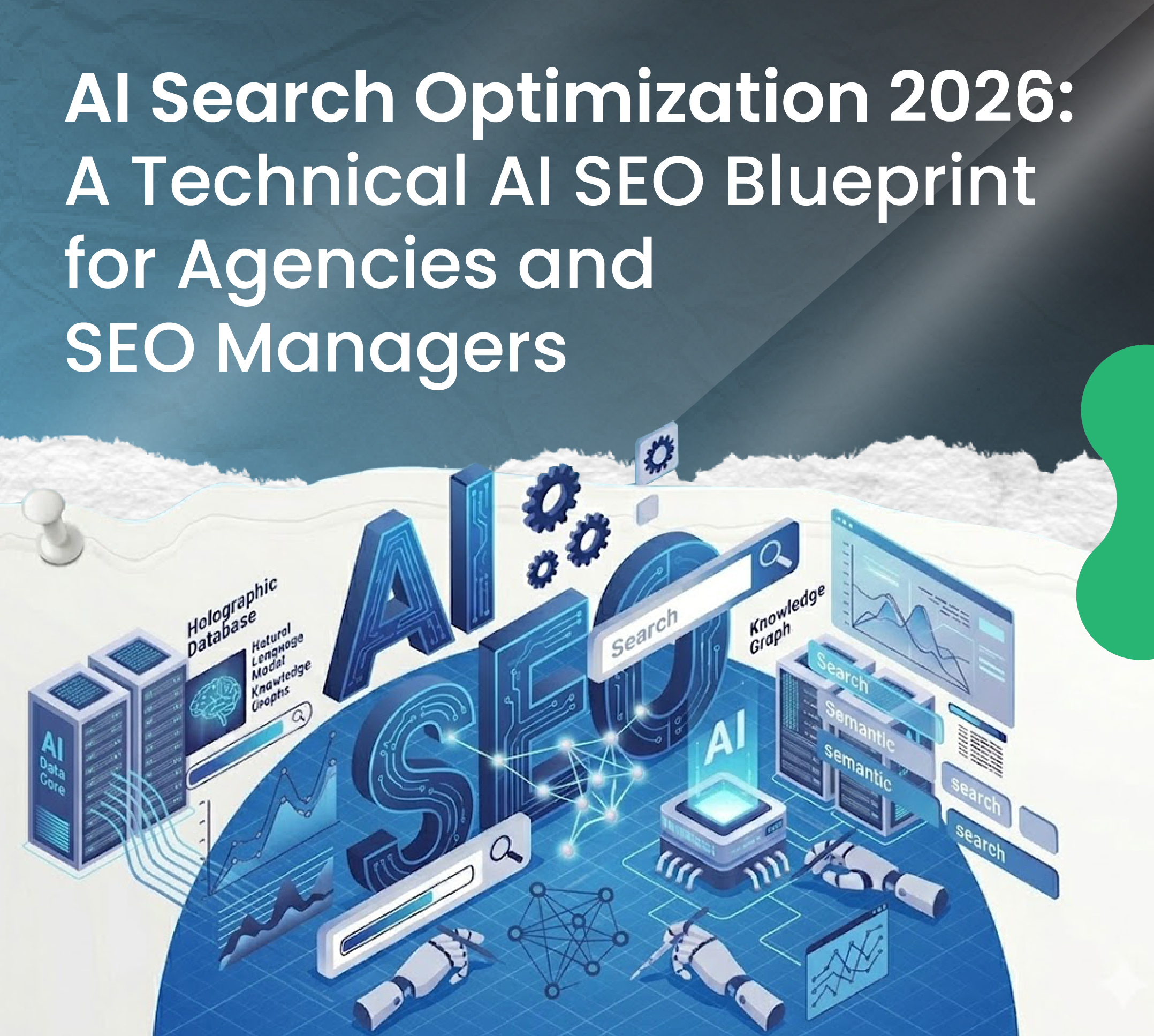
Most agencies are still running 2023 SEO playbooks in a 2026 search environment. The fundamentals have not disappeared. But the terrain has shifted significantly enough that executing the same strategy in the same way is now producing diminishing returns for a growing number of clients.
AI Search Optimization is not a replacement for SEO. It is an upgrade to it. And in 2026, it is the upgrade that separates agencies producing consistent organic wins from those struggling to explain why rankings are holding but traffic and conversions are declining.
This is the technical AI SEO blueprint we build from at IMS nHance: what has changed, what it means for your technical decisions, and exactly where to focus your agency’s efforts right now.
Why AI Search Has Changed the SEO Rulebook in 2026
The shift is not theoretical. AI search engines now mediate a meaningful share of commercial queries in major markets. Google AI Overviews appear at the top of search results for millions of queries daily. Perplexity, ChatGPT Search, and Microsoft Copilot are handling research and purchase-stage queries that previously flowed exclusively through traditional organic search.
The consequence for agencies is specific: ranking position is no longer the complete picture. A page can hold its position at rank 3 while an AI Overview at the top of the same SERP answers the user’s question completely, eliminating the click. Traffic drops. Conversions drop. The ranking report still looks fine.
That is the gap that AI search Optimization closes. It is the work of making your content visible not just to search crawlers, but to the AI systems that decide what answer to surface before the user ever sees a ranked result.
AI Overviews now appear on over 47% of all Google searches in the US, up from 11% in mid-2024.
Source: BrightEdge AI Search Impact Study, Q1 2026
What We Mean by AI Search Optimization
AI search Optimization is the practice of structuring your content, technical setup, and brand signals so that AI-powered search systems select, cite, and recommend your content in their responses. It sits at the intersection of traditional SEO, Answer Engine Optimization (AEO), and structured data strategy.
It is not a single tactic. It is a system of connected decisions across content structure, technical implementation, and brand authority that together determine whether AI search treats your content as a trusted source or a background signal.
For agency owners, it is a service line upgrade and a client retention tool: the agencies who can demonstrate AI search visibility alongside traditional ranking metrics are delivering a fundamentally more complete service.
For SEO managers, it is a technical discipline with specific implementation requirements that map directly onto existing workflows, once you know where to focus.
The Technical AI SEO Blueprint: 7 Pillars
These are the seven areas where technical decisions directly determine AI search visibility. They are ordered by implementation priority, not by importance: all seven matter, but some unlock others.
Pillar 1: AI Overview and Featured Snippet Architecture
AI Overviews draw heavily from content that already ranks in featured snippets. This makes featured snippet Optimization the first technical priority in any AI SEO strategy. The structure is the same: a direct, concise answer (40 to 60 words) immediately beneath a question-formatted heading, followed by supporting context.
What changes in the AI Overview context is that the answer needs to be self-contained. AI systems extract and synthesize. If your answer requires surrounding context to make sense, it will not be pulled cleanly. Write every target answer as if it will be read in isolation.
Standout Actions
- Audit your highest-traffic pages for question-formatted H2s and H3s with direct answers beneath them
- Write answer paragraphs in 40 to 60 words, declarative, present tense, with the key term in the first sentence
- Target ‘People Also Ask’ questions explicitly: each one is a potential AI Overview placement
- Use SERPerator or SGE testing tools to check which of your target queries currently trigger an AI Overview
Pillar 2: Schema Markup and Structured Data
Schema markup is the most underimplemented technical SEO for AI lever available to agencies right now. It communicates your content’s structure to AI systems in machine-readable terms, enabling more accurate extraction and citation.
The schema types that carry the most weight for AI search visibility in 2026 are FAQ, HowTo, Article, Product, Review, and Organization. The priority is FAQ schema on any page targeting question-based queries, and Article schema with credible author markup on all editorial content.
Standout Actions
- Implement FAQ schema on every page targeting conversational or question-format queries
- Add Article schema with author name, credentials, and publication date to all blog and editorial content
- Implement Organization schema with consistent NAP (name, address, phone) data site-wide
- Validate all schema implementations via Google’s Rich Results Test and Schema.org validator after deployment
- Audit existing schema for errors: broken implementations actively suppress AI visibility
Pillar 3: E-E-A-T Signals and Topical Authority
E-E-A-T (Experience, Expertise, Authoritativeness, Trustworthiness) is not a ranking factor in the traditional sense. It is a quality assessment framework that Google’s systems use to evaluate whether a source is credible enough to cite. In the AI Overview context, it is the primary filter between content that gets cited and content that gets ignored.
Building topical authority for AI search means two things: demonstrating that your content is written by people with genuine expertise, and building a comprehensive enough content cluster around your target topics that AI systems recognise your domain as a reliable reference point.
Standout Actions
- Add credible author bios to all editorial content: name, role, verifiable credentials, and links to author profile pages
- Build topical clusters: for every core service or topic, map the full question landscape and ensure your site has content that answers each one
- Earn third-party citations: AI systems read the wider web, and reputable mentions in industry publications carry E-E-A-T weight
- Cite your sources in content: links to credible external references signal intellectual honesty and increase AI trust
Pillar 4: Semantic Content Architecture
AI systems do not read pages in isolation. They map relationships between concepts. Semantic SEO for AI is the practice of building content that makes those relationships explicit: through internal linking structures, consistent use of related terminology, and content that covers a topic with genuine depth rather than surface-level keyword density.
The practical implementation is a content cluster model: a pillar page covering a topic comprehensively, supported by cluster pages addressing each sub-topic in detail, with clear internal linking between them. This structure signals topical depth to both traditional search algorithms and AI systems evaluating source credibility.
Standout Actions
- Audit your content for orphan pages: pages with no internal links pointing to them are invisible to AI mapping
- Build pillar and cluster content architecture for every core service or topic area
- Use consistent terminology: if you call something ‘AI search Optimization’ in one article and ‘AI SEO’ in another with no linking or cross-referencing, you are splitting the topical signal
- Add ‘related questions’ or ‘further reading’ sections to guide AI systems through your content cluster
Pillar 5: Technical Crawlability for AI Systems
AI crawlers behave differently from Googlebot in several important ways. Technical AI SEO requires auditing your robots.txt, crawl configuration, and page structure specifically against how AI systems access and index your content.
Key considerations: some AI crawlers respect robots.txt exclusions and some do not by default. If you are actively blocking AI crawlers from sections of your site you want cited, that is a direct visibility problem. Conversely, if you are allowing access to pages with thin or duplicate content, you are diluting the quality signal AI systems associate with your domain.
Standout Actions
- Audit robots.txt for unintended blocks on AI crawlers (GPTBot, ClaudeBot, PerplexityBot, Bingbot)
- Ensure page speed and Core Web Vitals meet baseline thresholds: slow pages reduce crawl frequency across all systems
- Clean up thin content, duplicate pages, and near-duplicate URLs that dilute domain quality signals
- Ensure all high-value pages are indexed: run a coverage audit in Google Search Console regularly
- Check that JavaScript-rendered content is accessible: some AI crawlers do not execute JS, making content invisible
Pillar 6: Brand Signal Consistency
AI systems synthesize information from across the web to build a picture of your brand. Brand consistency for AI search means ensuring that every touchpoint where your brand appears tells the same story: same name format, same service descriptions, same location data, same core claims.
Inconsistencies across your website, Google Business Profile, directory listings, social profiles, and third-party mentions create conflicting signals that reduce AI confidence in your brand as a citable source. This is one of the simplest fixes in AI search Optimization and one of the most consistently neglected.
Standout Actions
- Conduct a brand footprint audit: check your brand name, address, phone, and service descriptions across all listings
- Standardise your brand name format everywhere: ‘IMS nHance’ not ‘IMS Nhance’, ‘IMSnHance’, or ‘IMS n-Hance’
- Update outdated service descriptions in directories and third-party profiles
- Actively manage your Google Business Profile: completeness and recency both affect AI citation likelihood
Pillar 7: Conversational Query Optimization
The queries that trigger AI Overviews are almost always conversational and intent-rich: ‘how do I…’, ‘what is the best…’, ‘why does…’, ‘should I…’. Conversational SEO is the practice of mapping these query patterns and ensuring your content answers them directly and naturally.
This is distinct from traditional keyword Optimization. You are not optimizing for a two-word phrase. You are optimizing for a question that a real person would ask a trusted advisor. The best performing content in AI search reads like a confident expert giving a direct answer, not a page written to satisfy a keyword density target.
Standout Actions
- Use tools like AlsoAsked and AnswerThePublic to map the full question landscape for your target topics
- Rewrite section headings as questions where the query has high AI Overview prevalence
- Build dedicated FAQ sections that mirror the exact phrasing of questions your audience is asking in AI tools
- Test your target queries in ChatGPT, Perplexity, and Google SGE: if you are not cited, analyse what is and reverse-engineer its structure
The AI SEO Audit Checklist for Agencies
Use this checklist when onboarding a new client or running a quarterly review on an existing one. It covers the seven pillars in a sequenced audit workflow.
| Audit Item | Status |
1 | AI Overview prevalence mapped for all target keywords | To do / Done |
2 | Featured snippet structure (Q+A format) on high-priority pages | To do / Done |
3 | FAQ schema implemented and validated on question-targeting pages | To do / Done |
4 | Article schema with author markup on all editorial content | To do / Done |
5 | Author bios with credentials added to all content | To do / Done |
6 | Topical cluster map built for core service areas | To do / Done |
7 | Orphan pages identified and internally linked | To do / Done |
8 | robots.txt audited for unintended AI crawler blocks | To do / Done |
9 | Core Web Vitals passing on all key landing pages | To do / Done |
10 | JS rendering checked for AI crawler accessibility | To do / Done |
11 | Brand footprint audit completed across all listings | To do / Done |
12 | Conversational query mapping completed for target topics | To do / Done |
13 | FAQ sections reviewed against live AI-generated answers for target queries | To do / Done |
Where Most Agencies Are Getting This Wrong
Treating AI search Optimization as a separate project from SEO. The technical foundations are shared. The agencies delivering the best results are integrating AI SEO considerations into their standard workflow: content briefs include AI Overview mapping, technical audits include crawler configuration, and reporting includes AI citation tracking alongside traditional ranking metrics.
Optimizing for keywords, not questions. AI systems answer questions. Content that is structured around keyword phrases rather than question-answer pairs is progressively less well-suited to the queries AI Overviews are designed to address.
Ignoring schema until there is a problem. Schema is a proactive visibility tool, not a reactive fix. Agencies that implement it systematically on new content rather than retrospectively on underperforming pages compound the advantage over time.
Overlooking brand signal consistency. It is the highest-leverage, lowest-effort intervention in AI SEO and the one most consistently left undone because it feels administrative. It is not. It is foundational.
How IMS nHance Applies This Blueprint
At IMS nHance, this AI SEO blueprint is built into our standard client delivery workflow. New client onboardings include an AI visibility audit across all seven pillars. Quarterly reviews include AI Overview tracking, brand signal audits, and schema validation as standard line items alongside traditional SEO reporting.
We work with agency owners who want to offer this capability to their clients without building the in-house expertise from scratch, and with in-house SEO managers who need a strategic framework and delivery partner to execute it at scale. In both cases, the starting point is the same: knowing exactly where the AI visibility gaps are in your current setup.
Conclusion
AI search is not replacing SEO. It is raising its technical floor. The agencies and SEO managers who treat AI search Optimization as a distinct discipline, built on structured data, semantic content architecture, E-E-A-T signals, and conversational query mapping, are the ones building durable competitive advantages for their clients right now.
The blueprint exists. The question is whether you are building to it.
Most agencies rank. Few get cited. Find out which side of that line your clients are on. Talk to IMS nHance.