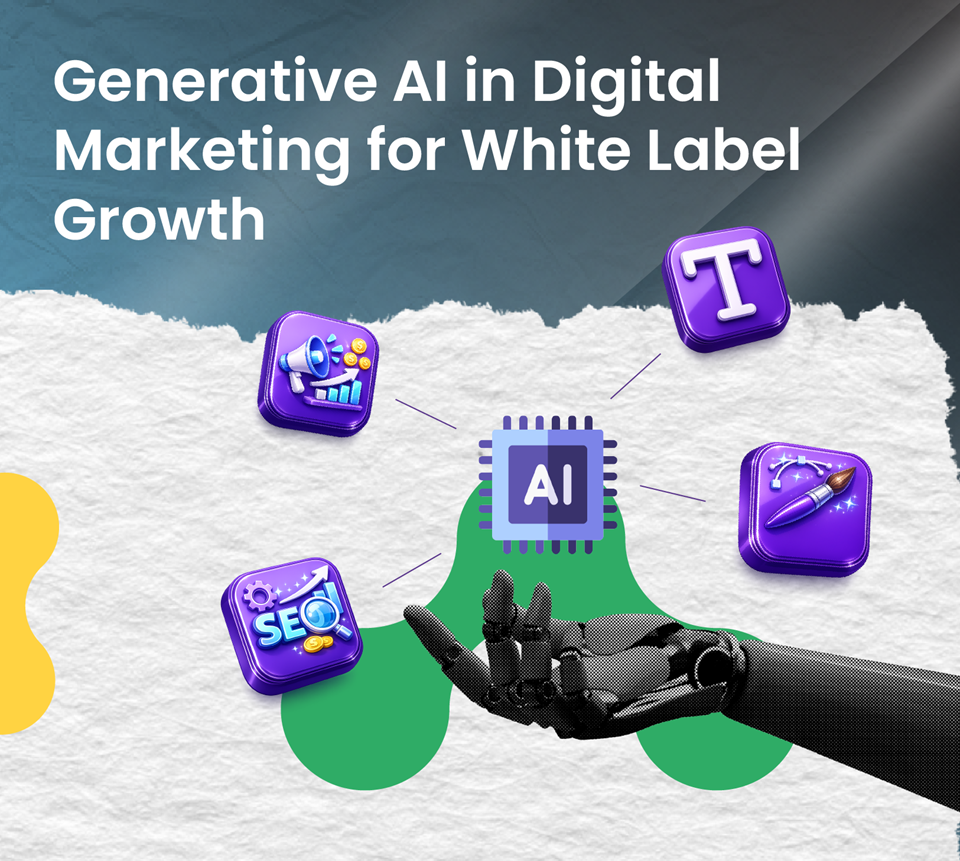
Generative AI in digital marketing is rapidly redefining how agencies scale, execute, and protect profitability. Within white label marketing models, AI enables agencies to deliver enterprise-level capabilities without heavy infrastructure investments. This blog explores how agencies can strategically adopt AI while maintaining quality, compliance, and client trust.
The Role of AI in White Label Models
Agencies utilizing generative AI in digital marketing through white label partnerships can deploy sophisticated automation without heavy capital investment. This model enables firms to offer proprietary-feeling tools for content, analytics, and strategy. By integrating these systems, agencies ensure consistent delivery, rapid scalability, and enhanced profit margins in a competitive global landscape.
Benefits of AI in Digital Marketing: Driving Operational
Efficiency
The most immediate benefits of ai in digital marketing is the radical optimization of resource allocation. Agencies can now automate the ingestion of vast datasets to produce actionable consumer insights in seconds.
Within a white label structure, these efficiencies allow smaller teams to deliver the same output as much larger competitors. Utilizing these tools often leads to a more impressive case study record by demonstrating significant improvements in lead quality and campaign velocity.
Key Takeaways:
Operational Arbitrage
Agencies use AI to produce high-volume output with minimal human overhead.
Data Velocity
Machine learning processes consumer data faster than manual analysis.
Quality Standardization
Automation removes the variance often found in human-led execution.
Strategic automation minimizes human error while ensuring that every client deliverable meets a standardized benchmark of excellence. This consistency is the primary driver of long-term client retention and agency reputation.
How to Use AI in Digital Marketing: A Strategic Framework
Determining how to use ai in digital marketing requires a systematic evaluation of your current service stack. Organizations should prioritize automating high-volume, repetitive tasks such as ad copy variations and initial SEO audits.
By embedding these capabilities into your existing solutions, you create a seamless experience for the end client. The objective is to move from manual execution to a supervised automation model where strategists oversee the machine’s output. This approach ensures that the technology remains an extension of human expertise rather than a replacement for it. Proper implementation requires a robust feedback loop to constantly refine the algorithms based on real-world performance data.
Key Takeaways
Workflow Integration
Embed AI into existing service pillars rather than using it as a standalone tool.
Supervised Automation
Maintain human oversight to ensure brand alignment and factual accuracy.
Iterative Refinement
Use campaign performance data to retrain and sharpen AI prompts.
White Label AI Digital Marketing: Scaling Without Technical Debt
Adopting a white label ai digital marketing strategy allows an agency to remain technologically relevant without the burden of software maintenance. For agencies, this means accessing cutting-edge large language models and predictive tools under their own brand identity.
This arrangement is a core component of how to future-proof your agency in 2026 with white label digital marketing services. It effectively transfers the risk of technological obsolescence to the white label provider, who handles all updates and infrastructure security. Agencies are then free to focus on relationship management and high-level strategy, which are the true drivers of firm value.
Best Free AI Tools for Digital Marketing: Bridging the Capability Gap
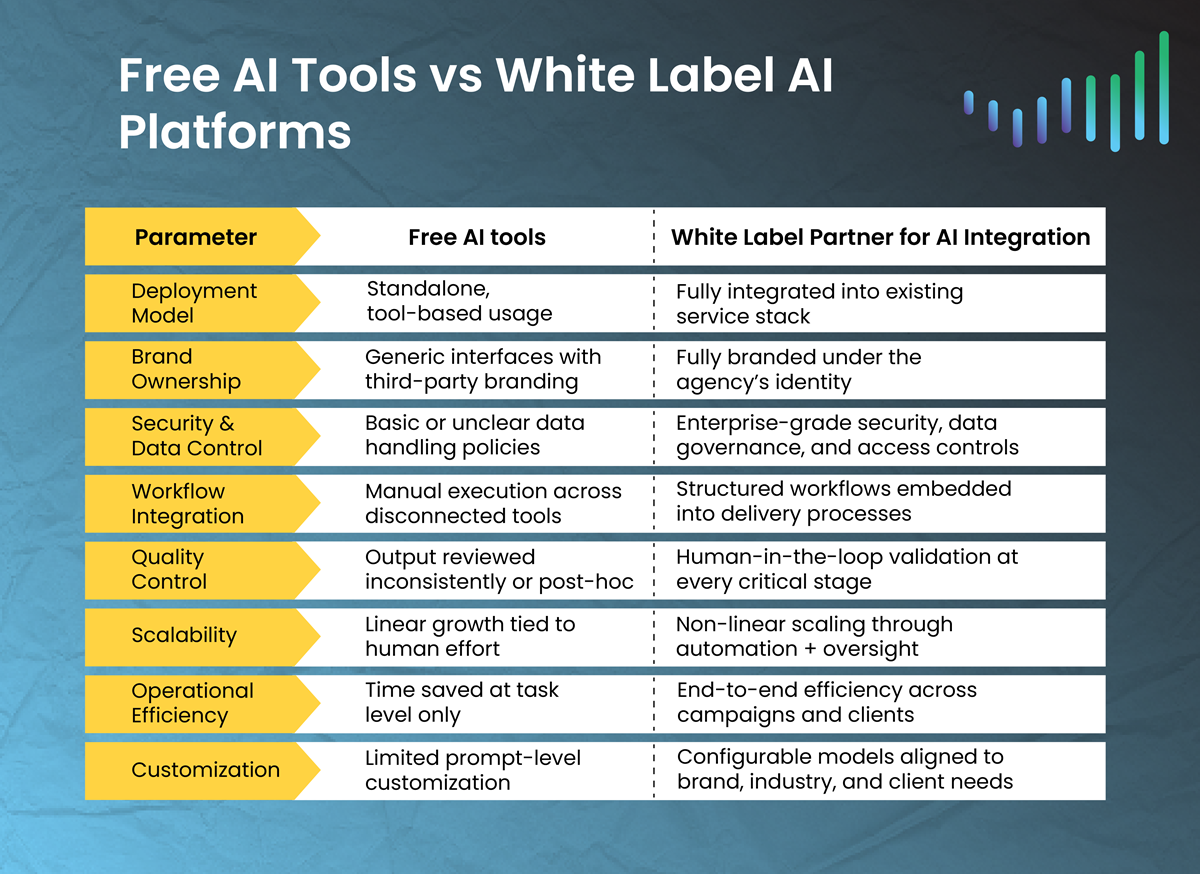
Many firms begin their automation journey by identifying the best free ai tools for digital marketing to handle foundational tasks. Tools like basic generative text models or open-source image creators offer a cost-effective way to test new workflows.
However, the true value for a professional agency lies in moving beyond these standalone tools into an integrated ecosystem. A white label partner provides the necessary cover that turns a generic tool into a professional, secure service offering.
This synthesis ensures that client data remains protected while the agency benefits from the latest innovations in the open-source community. Transitioning from free tools to a branded platform marks the evolution from a vendor to a strategic partner.
Cons of AI in Digital Marketing: Managing Risk and Quality Control
It is crucial to address the cons of ai in digital marketing, specifically regarding output accuracy and intellectual property. Generative systems can occasionally produce hallucinations or biased content that does not align with a client’s brand values.
Furthermore, the legal landscape regarding AI-generated content is still evolving, requiring agencies to stay vigilant about copyright standards. To mitigate these risks, agencies must establish a human-in-the-loop protocol for every piece of automated content.
This ensures that every deliverable undergoes a rigorous editorial review to maintain factual accuracy and brand tone. Transparency with clients regarding the use of AI also builds a foundation of trust and professional integrity.
Key Takeaways
Hallucination Risk
AI can generate plausible but false information necessitating expert review.
Compliance Needs
Agencies must navigate evolving copyright and data privacy regulations.
Editorial Oversight
Human intervention is required to maintain emotional resonance and tone.
Will Digital Marketing Be Replaced by AI? Understanding the Hybrid Model
A common concern among industry professionals is whether will digital marketing be replaced by ai in the coming years. Current trends suggest that while AI will handle the execution of data-heavy tasks, human intuition remains vital for creative storytelling.
The future of the industry lies in a hybrid model where machines handle scale, and humans provide the emotional resonance. Technology is a force multiplier, but the strategic direction of a campaign still requires a human architect.
AI Agents for Digital Marketing: Enabling Autonomous Operations for Agencies
The next phase of digital marketing innovation centers on AI agents that facilitate white label marketing agencies automate complex marketing operations for their clients. These agents go beyond static tools by executing multi-step workflows with minimal supervision for monitoring performance, interpreting data signals, and taking corrective action in real time.
For instance, an AI agent can identify a 10% spike in Cost-Per-Click (CPC) on a Saturday and automatically reallocate budget toward a better-performing secondary channel without manual intervention. By embedding such intelligence into their service stack, white label providers become strategic enablers, providing partner agencies the strength to deliver always-on optimization at scale.
Career Impact: How White Label Agencies Are Augmenting AI Digital Marketing Jobs
As automation becomes embedded into service delivery, white label marketing agencies play a critical role in enabling partner agencies adapt to the evolving nature of AI digital marketing jobs. Traditional roles are no longer being replaced; instead, they are being augmented with new expectations around AI fluency, prompt engineering, and analytical oversight.
Marketers are increasingly required to audit AI-driven decisions, refine prompts, and manage intelligent production pipelines supported by generative AI. White label partners that invest in AI-led workflows enable agency teams to become more productive while focusing on higher-value strategy, creativity, and client advisory work.
Analyzing the 7 white label marketing trends agencies must act on in 2026 provides a guide to getting the most successful partnership in this shifting era.
Strategic Implementation: Choosing an AI in Digital Marketing
For leadership teams, one insight is clear: long-term success lies in partnering with providers that deliver integrated support, operational intelligence, and scalability, not just standalone tools or platforms. Such resources offer deep dives into machine learning logic, data ethics, and the future of consumer behavior.
Rather than focusing solely on AI-driven automation, IMS nHance supports agencies with purpose-built agents and human-in-the-loop expertise that streamline campaign management, performance monitoring, reporting, and cross-channel execution.
By embedding generative AI into core marketing workflows while maintaining operational continuity, white label partners can scale efficiently, improve margins, and deliver consistent, high-quality outcomes. Understanding the why behind the technology allows agency owners to make better investment decisions regarding such partnerships.