The marketing landscape of 2026 will look nothing like it does today. As brands grapple with shrinking budgets, rapid AI integration, and the demand for speed, outsourcing is shifting from being a cost-saving hack to a core growth strategy.
What began as a way to “get work done cheaper” is now a strategic partnership model where brands tap into global talent, data-driven insights, and on-demand scalability — without the weight of overheads.
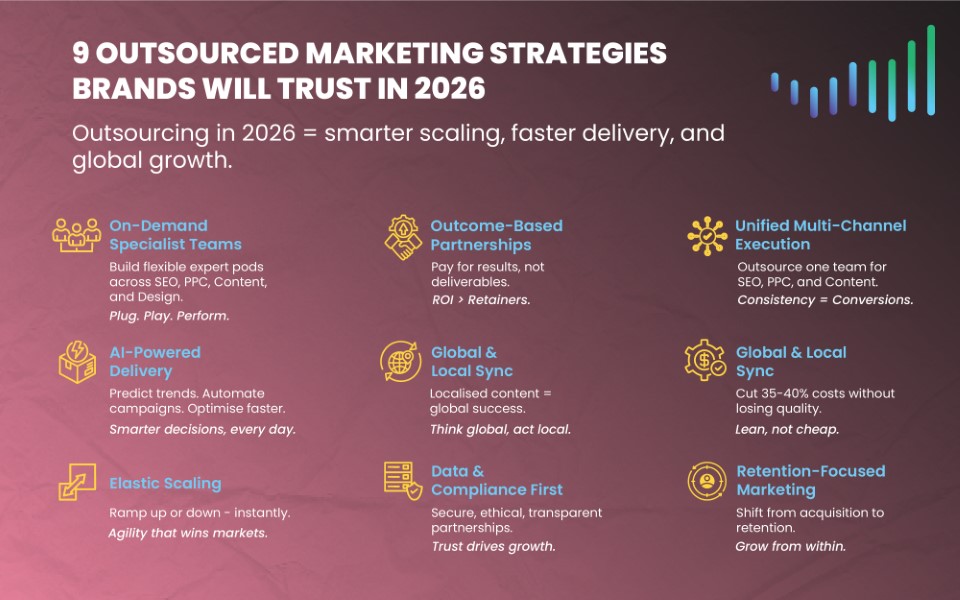
Here are the nine outsourced marketing strategies brands will trust on in 2026 – the very trends that will separate agile brands from the ones still hiring slowly, spending heavily, and scaling late.
Strategy 1 – Specialist On-Demand Teams
The days of one in-house generalist handling it all are gone. Brands now seek specialised, on-demand teams – experts in SEO, programmatic ads, marketing automation, or conversion copywriting, that can plug in instantly.
According to Bruce Clay’s 2025 marketing study, over 46% of B2B organisations plan to operate in a hybrid in-house + outsourced model by 2026.
These agile teams deliver niche expertise without long-term hiring commitments. Brands use them to manage campaign surges, launch new markets, or execute high-skill initiatives like marketing automation or CRO.
- Pro Tip: Maintain a pre-vetted roster of 2-3 specialised partners to avoid delays during campaign peaks.
Strategy 2 – Outcome-based Outsourcing Contracts
Brands are done paying for “deliverables”. They now pay for outcomes.
Rather than “24 blog posts a year”, expect contracts structured around business impact metrics like a 20% boost in organic traffic or a 15% increase in qualified leads and so on.
A 2025 Ranalli Marketing report notes that 58% of brands are shifting to performance based outsourcing models in 2026.
- Pro Tip: Align your SLAs with revenue or ROI outcomes – it keeps both the brand and
partner accountable for results, not just activity.
Strategy 3 – Full-channel Outsourced Coverage
Consumers no longer see channels – they perceive experiences. Brands must deliver a consistent narrative across SEO, paid, content, and social media.
Outsourced marketing partners are increasingly becoming full-funnel operators, managingthe entire ecosystem for coherence and efficiency.
This integration ensures seamless attribution, unified reporting, and consistent messaging, something most internal teams struggle with across silos.
- Pro Tip: Consolidate your agency stack. Fewer vendors = cleaner data + unified creative direction.
Strategy 4 – Automation, AI & Enhanced Data Analytics
2026 will be the year when brands outsource their AI stack along with marketing.
From predictive lead scoring to dynamic ad personalisation, AI-powered outsourced teams will help brands make sense of data faster than in-house teams bogged down with legacy tools.
“Companies outsourcing analytics will see 30% faster decision cycles,” reports ImpactMyBiz (2025).
- Pro Tip: When choosing partners, ask about their martech stack – look for expertise in tools like HubSpot, GA4, Looker Studio, and predictive AI models.
Strategy 5 – Global & Multilingual Execution Through Outsourcing
Global expansion is easier than ever — and outsourcing makes it cost-effective and culturally precise.
Brands can now collaborate with distributed teams that understand local markets, languages, and customer behaviour, from North America to APAC.
- Pro Tip: Hire partners that can localise content and adapt messaging without losing
brand voice. Global reach starts with cultural fluency.
Strategy 6 – Cost Efficiency Without Compromising Quality
Outsourcing will remain a strategic lever for doing more with less.
In 2026, it is not just about cutting costs; it is about optimising ROI per dollar spent. The right partner brings tools, processes, and people under one predictable retainer, reducing hidden costs like training, subscriptions, and attrition.
A 2025 Deloitte study showed that brands outsourcing marketing functions saved up to 38% in annual operational costs.
- Pro Tip: Benchmark your internal cost per campaign before outsourcing. It will make ROI tracking simpler post-execution.
Strategy 7 – Flexible Scaling for Campaigns & Launches
Brands cannot afford hiring freezes or delays when launching new products or running time-sensitive campaigns.
That is where outsourcing offers elasticity, scaling talent up or down within days. Whether it is adding 3 designers for a product launch or 2 PPC specialists for a quarter, scalability defines 2026’s marketing agility.
- Pro Tip: Build modular retainer models with your partner. That way, scaling up doesn’t mean renegotiating contracts.
Strategy 8 – Brand Safety, Compliance & Ethical Outsourcing
With AI and automation flooding the digital ecosystem, brand safety and ethical outsourcing will take centre stage.
Brands will partner only with vendors that have clear data policies, GDPR compliance, and transparent workflow visibility.
- Pro Tip: Request quarterly compliance audits and NDAs that clearly define data
access, usage, and confidentiality terms.
Strategy 9 – Retention, Upsell & Partner Ecosystem Growth
Outsourcing is not only about acquisition anymore – it is about long-term retention and growth.
The best outsourced teams now manage customer engagement, upsell campaigns, and community retention strategies, ensuring that the marketing funnel does not stop at MQLs.
- Pro Tip: Treat your outsourced team as an extension of your brand, not a vendor. Their success compounds your lifetime customer value.
Conclusion
As we enter 2026, the line between in-house and outsourced marketing will continue to blur.
Outsourced marketing is no longer a support arm – it’s a strategic growth engine. Whether you’re looking for scalability, specialised expertise, or cost efficiency, the brands that master this hybrid model will win the decade ahead.