
The digital-marketing landscape is evolving faster than ever. Agencies that lean on in house teams alone are hitting capacity walls – while tech, talent, and client expectations keep rising. According to industry data, the white-label marketing market is projected to reach USD 99 billion by 2026 (Source: Amra And Elma).
For agencies, that means an opportunity: instead of building every capability internally, you can partner, plug in, and pivot faster. In this article, we’ll unpack 7 white-label marketing trends that agencies must act on in 2026, so you can scale smarter, preserve margins, and retain competitive advantage.
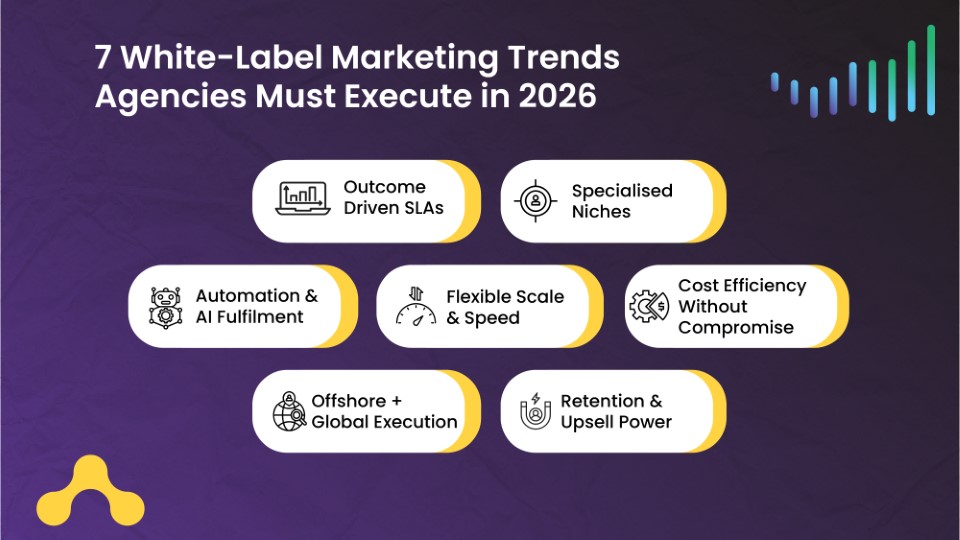
Trend 1 - Outcome-Driven SLAs and Transparent Reporting
White-label partnerships are no longer just about outsourcing tasks, they’re about driving business outcomes. Agencies that adopt outsourced models often report significantly faster growth and healthier margins, thanks to access to specialized expertise and scalable delivery.
What this means for your agency:
- Define SLAs such as “Rank one new keyword in Top 3 within 90 days” or “Improve paid-ads CPL by 15%”.
- Integrate branded dashboards so your client sees your logo – and your partner’s work remains behind the scenes.
- Align reporting with your value proposition, not just output.
Trend 2 - Specialised White-Label Niches Over Broad Resellers
Agencies increasingly prefer speciality partners rather than generalists. In 2026, niches like local-SEO, e-commerce PPC, multilingual content, or technical audits are differentiators.
Strategic tip:
- Map your clients’ top needs and build a catalogue of 2–3 niche white-label offers.
- Position the partner as “our specialist backend team” rather than “vendor”.
Trend 3 - Automation & AI-Enabled Fulfilment
Automation isn’t a luxury – it’s stakes on the table. Over 60% of agencies cite AI-driven content and broader automation as key drivers for 2026.
Action steps:
- Choose white-label partners with branded automation tools (client dashboards, reporting portals, API integrations).
- Automate certain processes to free your internal team for high-value work (strategy, client relationships).
Trend 4 - Flexible Scale & Delivery Speed
Speed matters. Seasonal spikes, campaign launches or new niche offers demand quick execution. White-label partnerships give agencies elastic capacity. Market research shows 66% of businesses with more than 50 employees outsource at least one marketing function (Source: DemandSage).
Checklist for your agency:
- Ensure the partner can handle scale-ups without quality loss.
- Build service packages that allow rapid launch (e.g., “30-day onboarding, go live in 90 days”).
- Always maintain your client liaison role so brand control stays with you.
Trend 5 - Cost Efficiency Without Compromise
When you outsource delivery, you can avoid full-time staff training, software licensing and overheads. Analysts report agencies using white-label services cut costs but kept or improved quality.
How to position this:
- Present cost-comparison charts: In-house vs white-label.
- Highlight reuse of partner infrastructure rather than reinventing.
- Use internal case snapshots (anonymised) to show margin uplift.
Trend 6 - Offshore + Global Service Models
Delivering globally means having global execution. White-label partners with offshore capacity to help agencies serve multiple geos, manage time zones and deliver 24/7. The white-label software market is forecast to accelerate with a CAGR of ~9.8% from 2026 to 2033.
Your angle:
- Use the term “offshore digital marketing services” in blogs and supportive copy (not necessarily on key pages).
- Develop branded process flows: “Your backend team + our strategy = client success”.
Trend 7 - Retention & Upsell Acceleration
Retention wins matter. Agencies leveraging white-label services report ~42% higher client retention.
Focus points:
- Use the partner to expand your service catalogue (cross-sell).
- Build tiered service models: e.g., Basic (SEO) → Standard (SEO + PPC) → Premium (Full stack).
- Show clients the value of scale (not only new clients) – “growth with fewer headaches”.
Conclusion
2026 will not wait for agencies that stay stuck in legacy models. If you’re relying solely on in-house teams, you may be limiting scalability, agility and profitability. Instead, lean on a trusted white-label partner as your growth engine so your agency can remain strategic, client-centric and future-ready.